VISTA’s 11-year near-infrared survey reveals that the Small Magellanic Cloud is being stretched and losing stars under the tidal influence of the larger Large Magellanic Cloud. Millions of stellar motions show large-scale outward flows rather than orderly rotation, with average speeds near 10.6 miles (17 km) per second. The alignment of this flow toward the LMC and the distinct motion of older red giants point to repeated gravitational encounters over billions of years.
Large Magellanic Cloud Is Tearing Its Smaller Neighbor Apart, New VISTA Study Finds
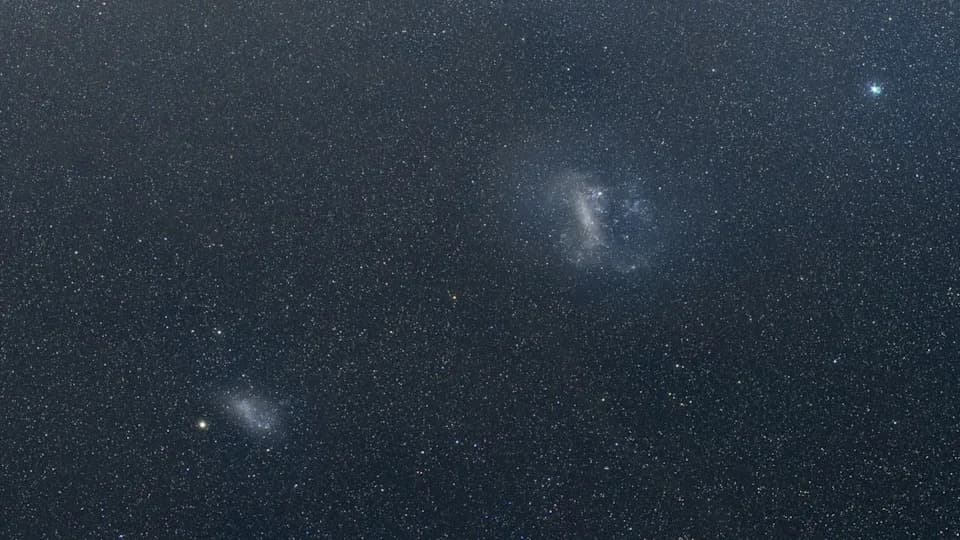
This visible light mosaic shows the LMC and SMC. Separated by about 21 degrees, the two galaxies are readily visible from the Southern Hemisphere as faint, glowing patches in the night sky. . | Credit: Axel Mellinger, Central Michigan University/NASA Visualization Studio
The Small Magellanic Cloud (SMC) appears to be unraveling under the tidal pull of its larger companion, the Large Magellanic Cloud (LMC). New eleven-year observations from the VISTA Survey of the Magellanic Clouds (VMC) show millions of individual stellar motions that reveal large-scale outward flows of stars from the SMC — a pattern pointing back toward the LMC and inconsistent with simple disk rotation.
What the VISTA Survey Measured
Using the 4-meter Visible and Infrared Survey Telescope for Astronomy (VISTA) at the European Southern Observatory’s Paranal site in Chile, researchers combined more than a decade of near-infrared imaging to track the motions of millions of stars in both Magellanic Clouds. VISTA’s ability to see through dust and its long time baseline produced unusually precise ground-based kinematic maps.
Key Discovery: Tidal Expansion, Not Rotation
Earlier studies suggested the SMC showed signatures of rotation. The new VISTA data overturn that interpretation: many stars are streaming outward from the SMC’s center along an axis that, as seen from Earth, runs southeast to northwest. If that axis is extended it points back toward the LMC — exactly what tidal forces would produce as the larger galaxy stretches and pulls stars from the side of the SMC nearest to it.
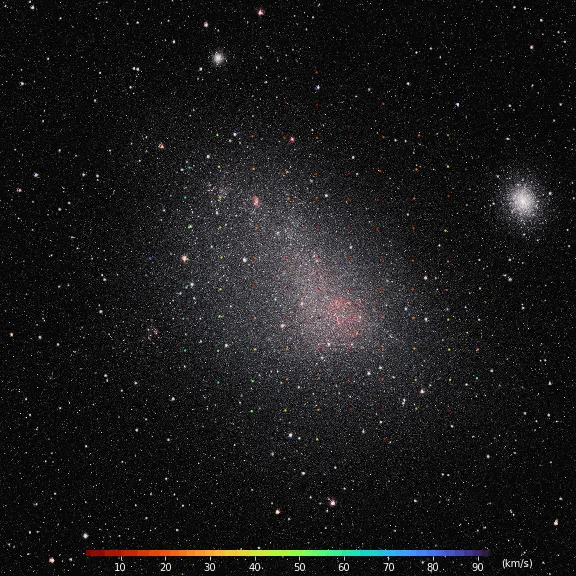
An animation indicating the radial motion of the stars in the SMC. | Credit: ESO/VISTA VMC/AIP/S. Vijayasree
"The results reveal large-scale tidal expansion throughout the SMC and challenge long-standing assumptions that the Small Magellanic Cloud behaves like a rotating disk," said Sreepriya Vijayasree of the Leibniz Institute for Astrophysics Potsdam (AIP), lead author of the study.
Scale and Timescales
The stars in the outward flow have an average speed of about 10.6 miles (17 kilometers) per second. At those velocities, individual stars can travel several thousand light-years over a few hundred million years, implying the SMC has been distorted over very long timescales — potentially billions of years — and was likely more compact in the past.
Signatures Of Older Encounters
VISTA also finds that older red giant stars (roughly 2 billion years old) share a coherent northward bulk motion. That separate kinematic signature points to an additional gravitational interaction in the SMC’s past — possibly occurring well before the Clouds’ current close approach to the Milky Way, since many models indicate the Magellanic Clouds are on their first passage around our galaxy.
Implications And Future Fate
The study shows repeated LMC–SMC encounters have dominated the SMC’s internal kinematics. Interactions with the Milky Way’s halo are also slowing the pair, and recent simulations predict the Magellanic Clouds will likely merge with the Milky Way in several billion years. For now, the LMC continues to exert a disruptive, tidal influence on its smaller sibling.
Study Source: The research team led by Sreepriya Vijayasree and Florian Niederhofer published the results in the journal Astronomy & Astrophysics.
Help us improve.