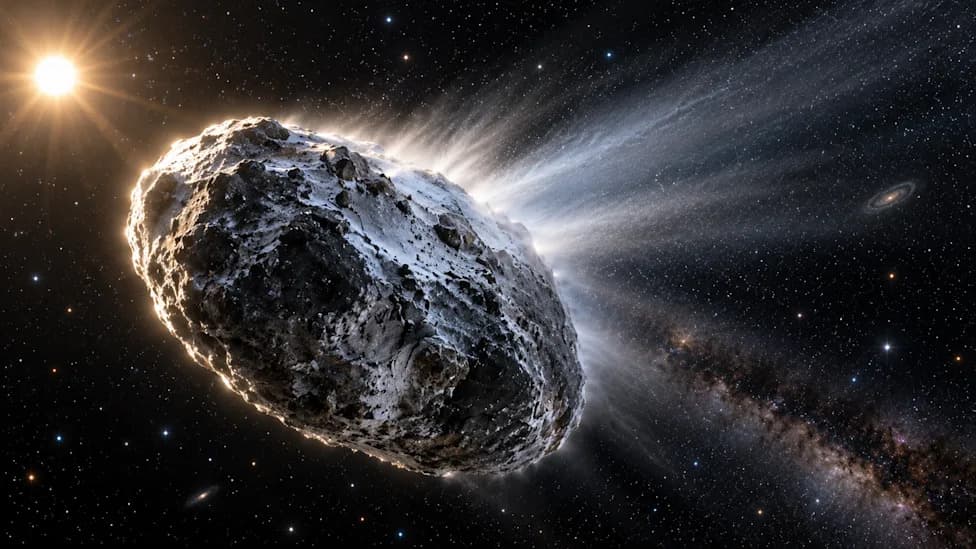
A small Kuiper Belt object, (612533) 2002 XV93, revealed a very thin exosphere during a stellar occultation on 10 January 2024. Surface pressure is estimated at roughly 100–200 nanobars — millions of times thinner than Earth's atmosphere and far below Pluto's ~10 millibars. Scientists propose either a recent cometary impact (a transient atmosphere) or cryovolcanic outgassing as possible sources; follow‑up spectroscopy with JWST and continued monitoring will help determine which is correct.
Tiny Kuiper Belt Object Found To Have a Thin Atmosphere — Origin a Mystery
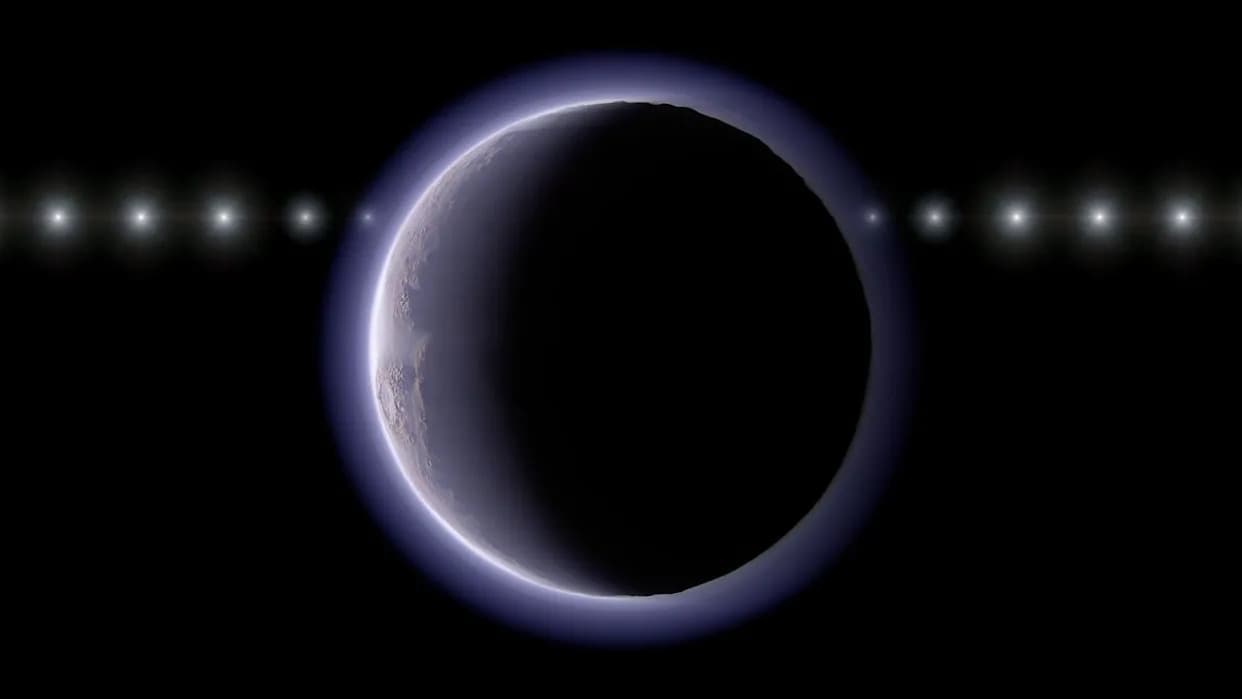
A very small body in the distant, icy outskirts of the solar system has unexpectedly been found to possess an atmosphere, and astronomers are unsure how it formed.
The object, catalogued as (612533) 2002 XV93, is a trans‑Neptunian object (TNO) in the Kuiper Belt and specifically a "plutino," locked in a 2:3 orbital resonance with Neptune — it completes two orbits of the Sun for every three of Neptune's. At roughly 310 miles (500 kilometers) across, it is far smaller than Pluto (about 1,477 miles / 2,377 km in diameter).
How the Atmosphere Was Detected
The exosphere was detected during a stellar occultation on 10 January 2024, when (612533) 2002 XV93 passed in front of a magnitude 15 star. If the body were truly airless, the star's light would have extinguished abruptly as the object moved across it. Instead, observers recorded a gradual dimming and refracting of the starlight — the signature of a tenuous atmosphere.
Japanese professional and amateur astronomers, led by Ko Arimatsu of the Ishigakijima Astronomical Observatory at the National Astronomical Observatory of Japan (NAOJ), coordinated observations from four sites in Japan. Instruments ranged from the 1.05‑meter (3.4‑foot) professional telescope at Kiso Observatory to amateur 200 mm and 250 mm (8‑ and 10‑inch) telescopes equipped with sensitive CMOS cameras capable of recording the gradual light curve.
What Was Measured
Analysis indicates the exosphere is extremely tenuous, with an estimated surface pressure of roughly 100–200 nanobars — about 5 million to 10 million times thinner than Earth's atmosphere. By comparison, Pluto's atmosphere averages around 10 millibars at the surface, many orders of magnitude denser than this newly detected exosphere.
The composition of the exosphere remains uncertain. On Pluto, a nitrogen‑dominated atmosphere with traces of methane and carbon monoxide forms as surface ices sublimate near perihelion. However, previous observations with the James Webb Space Telescope found no clear evidence for nitrogen, methane, or carbon monoxide ices on (612533) 2002 XV93's surface. The object's surface temperature, roughly 40–50 kelvin (K), is far too cold for water ice or carbon dioxide ice to sublimate into gas under normal conditions.
Possible Origins
The team considers two main hypotheses, each with challenges:
Recent Impact: A cometary or icy impactor might have released gas that is now observed as an exosphere. Because the object's gravity is low and thermal escape is efficient, such a transient atmosphere would likely dissipate on timescales of order 1,000 years or less — implying we would have observed the object shortly after a rare impact.
Cryovolcanic Outgassing: Subsurface volatiles could be vented through cryovolcanic activity, providing a steady source of gas. But what mechanism could drive cryovolcanism on a ~500 km, very cold body is unclear.
Next Steps
Follow‑up spectroscopy, ideally with the James Webb Space Telescope, could identify specific gases in the exosphere and test whether known volatile ices exist beneath or on the surface. Continued occultation monitoring will track whether the atmospheric density declines (favoring a recent impact) or remains steady (favoring ongoing outgassing).
The findings were reported in Nature Astronomy on 4 May 2024 and challenge assumptions about which small bodies can host atmospheres. As the discovery shows, even modest Kuiper Belt objects may temporarily or intermittently support detectable exospheres.
Help us improve.