The warty comb jelly Mnemiopsis leidyi can revert from an adult to a larval form after severe stress, according to a 2024 study by researchers at the University of Bergen. In an experiment, 65 adults were starved for 15 days; 13 reverted to the larval form over the following weeks. Surgical removal of adult lobes prompted faster reversion in six of 15 operated animals (15 days), while some nonoperated animals reverted after about six weeks. The finding highlights developmental plasticity and raises questions about the underlying molecular mechanisms, though it does not imply human applications.
Comb Jelly Can 'De-Age' Into a Larva After Trauma — What It Might Reveal About Reverse Development

This Strange Sea Creature Can De-Age ItselfVladimir Venediktov - Getty Images
The warty comb jelly, Mnemiopsis leidyi, is a remarkable marine animal known for unusual biological traits such as strong regenerative ability and unusual feeding behaviors. A 2024 study led by Joan J. Soto-Angel and Pawel Burkhardt at the University of Bergen reports that adult M. leidyi can physically revert to a larval form after severe stress, including prolonged starvation or traumatic injury.
What the researchers observed
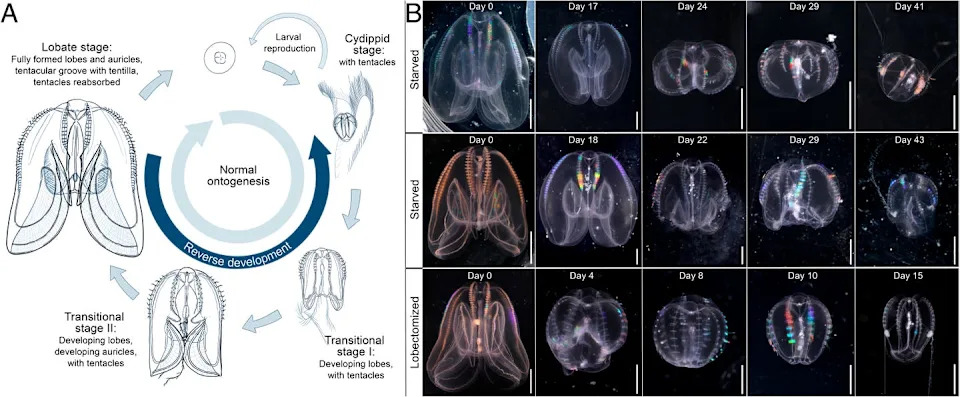
In a controlled experiment, the team isolated 65 adult comb jellies and withheld food for 15 days, then provided a sparse feeding regime (about once per week). Over subsequent weeks many adults reabsorbed the gelatinous lobes that mark maturity and resumed the morphology and feeding behaviors typical of cydippid larvae. Thirteen of the 65 specimens completed this reversal within several weeks.
To test whether more extreme physical damage would increase the likelihood or speed of reversal, the researchers surgically removed the adult lobes from 15 of the 65 animals. Of those operated individuals, six reverted fully to larval form within 15 days. By contrast, seven of the 50 nonoperated specimens later reverted after about six weeks. The results indicate that more severe stressors made reverse development both more likely and faster.
“Witnessing how they slowly transition to a typical cydippid larva, as if they were going back in time, was simply fascinating,” Soto-Angel said in a University of Bergen press release.
How this differs from other species
Proceedings of the National Academy of Sciences
This behavior resembles the life-cycle restart of the so-called "immortal jellyfish" (Turritopsis dohrnii), but differs in key ways. In Turritopsis the restart is a life-cycle reversal tied to reproduction and aging; in M. leidyi the reversal appears to function primarily as an active survival strategy under extreme stress.
Scientific implications and caveats
The authors emphasize that these findings highlight the plasticity of development in comb jellies and raise important questions about underlying molecular mechanisms — and about how the animal's simple nerve net reorganizes during reverse development. While intriguing, the results do not imply any immediate relevance to human aging or "immortality." Instead, they point to new directions for research into cellular reprogramming, regeneration, and the evolution of developmental flexibility across animals.
Where the research was published
The study appeared in the journal Proceedings of the National Academy of Sciences (PNAS) in 2024 and was conducted by researchers at the University of Bergen.
Help us improve.