NASA has released coordinated Hubble and JWST images that together form the "most comprehensive view of Saturn to date." Hubble's August 22, 2024 visible-light images highlight the planet's yellow hues from ammonia crystals and hydrocarbons, while JWST's November 29, 2024 infrared observations probe deeper atmospheric layers. The combined imagery reveals jet streams, storm remnants, a greenish polar tint that may indicate auroral activity, and vividly lit rings—advancing 3D studies of Saturn's atmosphere.
NASA Releases Most Detailed Saturn Images Yet — Hubble and JWST Reveal Storms, Rings and Polar Glow
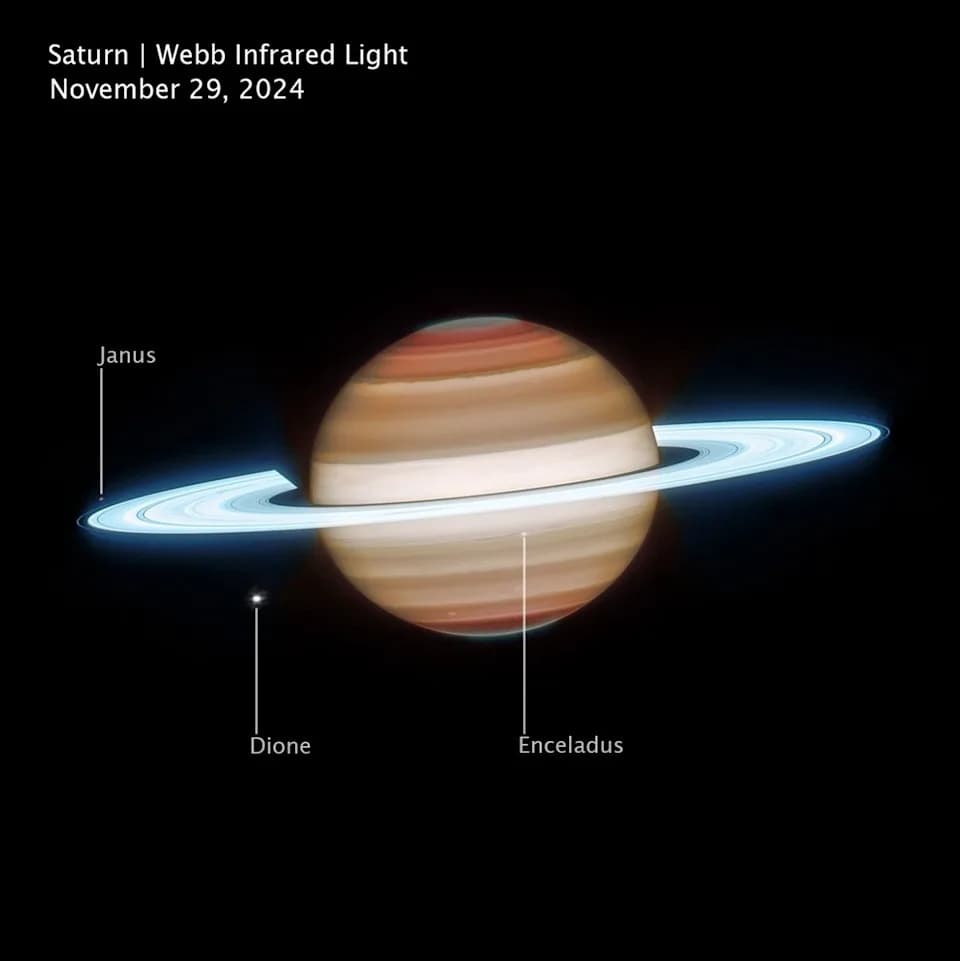
An infrared view of Saturn, captured on November 29, 2024, by NASA’s James Webb Space Telescope.Sign up for Today in Science, a free daily newsletter from Scientific American and join a community of science-loving readers.NASA/ESA/CSA/STScI (image); Joseph DePasquale/STScI (image processing)
NASA has released a striking new set of images that portray Saturn with unprecedented clarity, combining visible-light observations from the Hubble Space Telescope with deep infrared views from the James Webb Space Telescope (JWST). Taken on August 22, 2024 (Hubble) and November 29, 2024 (JWST), these images together offer what NASA calls the "most comprehensive view of Saturn to date."
Two Telescopes, Complementary Views
Hubble captured reflected visible light, emphasizing Saturn's characteristic yellow hues produced in part by sunlight-scattering ammonia crystals and hydrocarbons such as methane. JWST's infrared instruments probe deeper layers of the planet's atmosphere, revealing features hidden beneath the cloud tops. Launched more than three decades apart—Hubble in April 1990 and JWST in December 2021—the two observatories provide complementary perspectives that, when combined, let scientists study Saturn as a connected, three-dimensional system.
What the Images Show
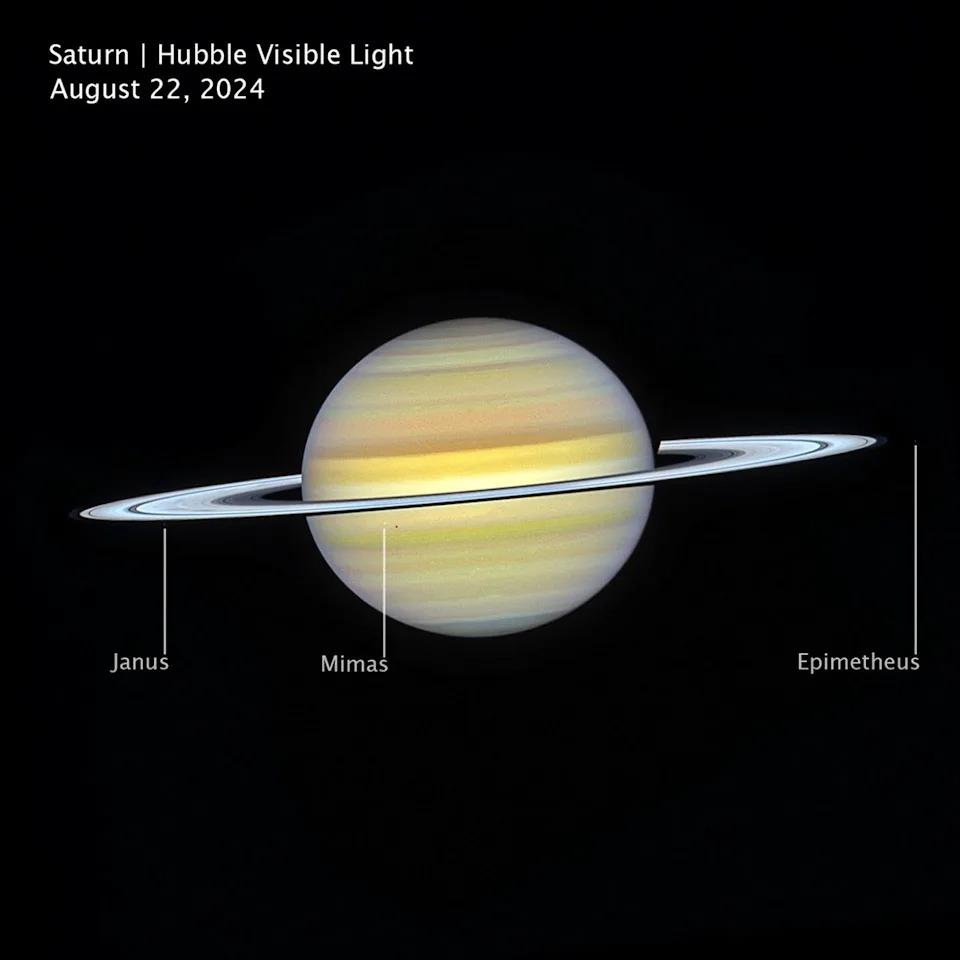
A visible-light image of Saturn, captured on August 22, 2024, by NASA’s Hubble Space Telescope.NASA/ESA/STScI/Amy Simon/NASA-GSFC/Michael Wong/U.C. Berkeley (image); Joseph DePasquale/STScI (image processing)
The new images highlight atmospheric turbulence across multiple scales: fast jet streams, the ragged remnants of past storms, and wave-like structures. JWST's infrared views also reveal a curious greenish tint around Saturn's poles. That coloration may arise from atmospheric gases or be related to auroral processes similar to Earth's northern and southern lights.
Saturn's ring system appears particularly vivid, with sunlight illuminating bands of primarily water ice mixed with rock and dust. The contrast between the planet's atmospheric features and the sharply defined rings helps researchers isolate and model different processes shaping the system.
"Together, scientists can effectively 'slice' through Saturn's atmosphere at multiple altitudes, like peeling back the layers of an onion," NASA wrote in the blog post accompanying the images. "Each telescope tells a different part of Saturn's story, and the observations together help researchers understand how Saturn's atmosphere works as a connected three-dimensional system."
Why It Matters
Long-term monitoring with Hubble plus JWST's deeper infrared sensitivity will help astronomers track how storms, jet streams, and polar activity evolve over time. These combined data sets improve 3D models of Saturn's atmospheric dynamics and help answer questions about composition, energy transport, and seasonal changes on the gas giant.
Image credits: NASA/ESA/CSA/STScI; image processing by Joseph DePasquale/STScI and collaborators.
Help us improve.