Researchers propose using fiber-optic cables laid on the lunar surface as distributed acoustic sensors to detect moonquakes. Lab studies led by Los Alamos show a single fiber can act like thousands of seismic sensors, and burial depth had little effect on signal clarity — simplifying robotic deployment. Thicker, stiffer cables increase signal strength but add mass, creating a trade-off for missions. The method could inform Artemis-era base design and track dust from landings.
Fiber-Optic Cables Could Turn the Moon Into a Massive Seismic Network for Artemis
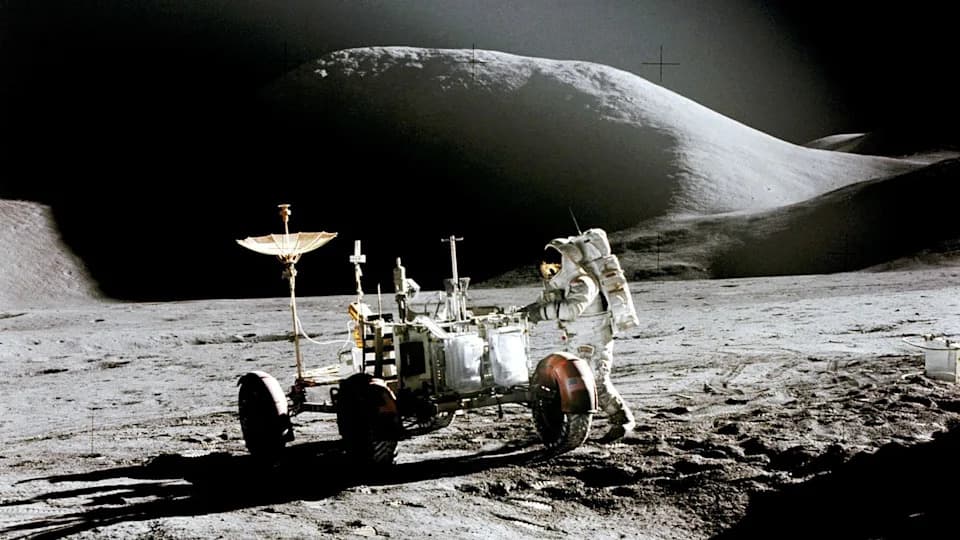
Apollo Astronaut James B. Irwin, lunar module pilot, works at the Lunar Roving Vehicle during the first Apollo 15 lunar surface extravehicular activity (EVA) at the Hadley-Apennine landing site. . | Credit: NASA
The moon may soon host a high-tech but lightweight seismic network: researchers propose unspooling fiber-optic cables across the lunar surface to detect moonquakes. Two recent Los Alamos–led studies argue that optical fibers used with distributed acoustic sensing (DAS) can act as thousands of seismic sensors along a single line, offering a lower-cost, lower-mass alternative to traditional seismometers for future robotic and crewed missions.
How Distributed Acoustic Sensing Works
DAS sends laser pulses through an optical fiber and measures tiny changes in the returned light caused by vibrations along the cable. Because every short segment of fiber can record motion, one cable can effectively provide dense, continuous spatial coverage without deploying hundreds or thousands of individual instruments.
Key Findings From the Studies
In a study published in February 2026 in Icarus, researchers tested fibers buried at multiple depths inside an indoor Los Alamos laboratory. They analyzed signals from recorded regional earthquakes and from simulated seismic waves and found that burial depth did not substantially affect signal clarity. That suggests robotic missions might simply lay fibers on the lunar surface rather than dig trenches, simplifying deployment.
The second paper, published March 17 in Earth and Space Science, showed that thicker, stiffer fiber-optic cables that maintain good contact with the ground produce stronger signals. However, increasing cable diameter and stiffness adds mass — a critical trade-off for space missions where every kilogram counts.
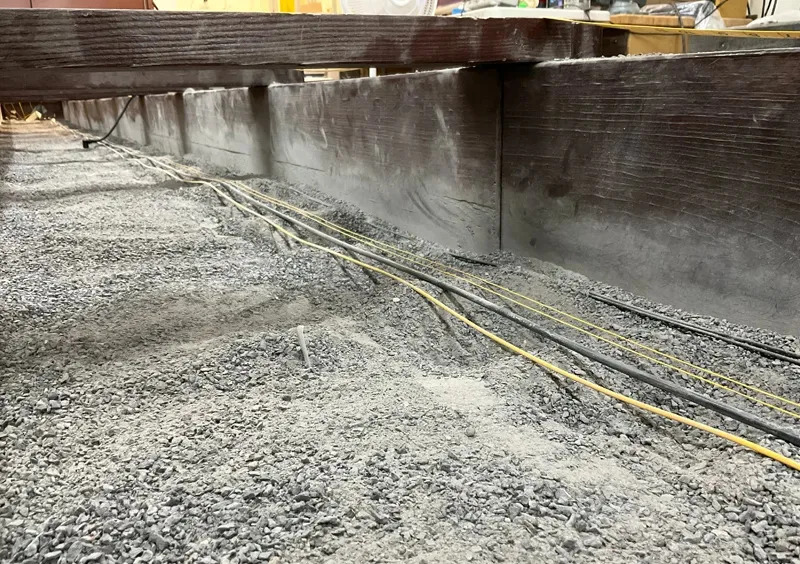
Fiber-optic cables lie on the surface and beneath crushed basalt in an indoor lab at Los Alamos National Laboratory to determine whether they could be used on the surface of the moon to detect moonquakes. The crushed basalt simulates the lunar surface. | Credit: Los Alamos National Laboratory
Why This Matters for Artemis
Moonquakes differ from earthquakes: without tectonic plates, the moon’s tremors come from tidal stresses from Earth, meteorite impacts and extreme thermal cycling. Seismic energy also dissipates slowly in the moon’s fractured interior, so shaking can persist longer than on Earth. Mapping this activity will improve understanding of the lunar interior — including the core and fault structure — and will be essential for designing safe habitats, landing pads and infrastructure for sustained presence under NASA’s Artemis program.
"Fiber-optic cables are lightweight, robust and inexpensive," said Carly Donahue, a scientist at Los Alamos National Laboratory and corresponding author on both studies. "We asked whether a robot or rover could lay fiber-optic lines for many kilometers without burying them and still obtain useful measurements. If feasible, it would be a much cheaper and more efficient way to gather data without requiring an astronaut to travel long distances."
Practical Benefits and Challenges
Advantages: fibers are lightweight, robust, and can provide continuous spatial coverage across many kilometers, which is ideal for robotic deployment. On the airless moon, environmental noise is lower than on Earth, so fibers placed on the surface can still pick up strong seismic signals without burial.
Challenges: thicker cables yield better signals but increase mass; maintaining consistent contact with uneven lunar regolith will be important; and the DAS electronics and laser interrogators must be adapted and hardened for the lunar environment. Mission planners will need to balance signal performance, launch mass, and deployment complexity.
Beyond Moonquakes
Distributed fiber sensing could also monitor how far dust and debris travel during landings — a key factor in assessing sandblast risks to nearby equipment and habitats. If validated on the moon, the approach could transform seismic and environmental monitoring for other planetary bodies as well as new applications on Earth.
For now, these studies point to a compelling possibility: the next major leap in lunar exploration might rely on repurposing terrestrial fiber-optic technology to map lunar shaking at unprecedented scale.
Help us improve.