President Trump’s threat to “obliterate” Iran’s power plants prompted immediate warnings from Tehran, including vows to damage regional energy and oil infrastructure and to close the Strait of Hormuz. The confrontation has already contributed to a roughly 30% rise in U.S. gasoline prices and risks further market disruption. Legal experts warn attacks on civilian power systems could violate the Geneva Conventions, while analysts say the standoff increases the chance of broader regional escalation.
Trump Ultimatum Backfires as Iran Threatens Regional Retaliation and Strait Closure
Evelyn Hockstein/REUTERS
President Donald Trump's Saturday ultimatum to “obliterate” Iran’s power plants unless Tehran lifted its chokehold on the Strait of Hormuz within 48 hours has sparked a swift and hostile response from Iran, raising the prospect of reciprocal attacks on civilian infrastructure and broader market disruption.
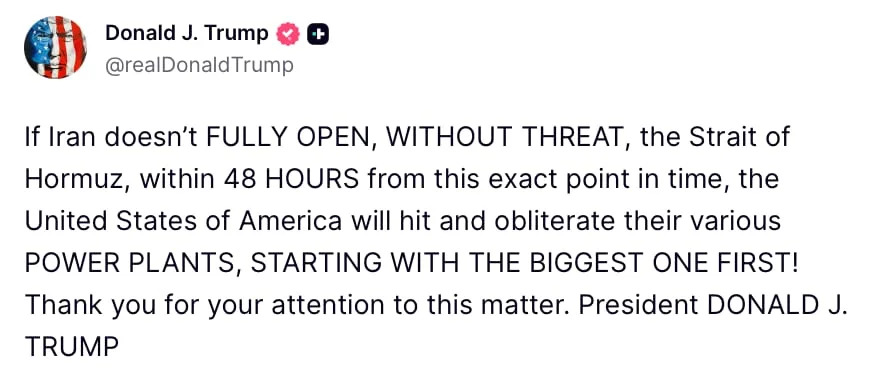
Trump threatened to “obliterate” Iranian power plants unless the Strait of Hormuz is reopened within 48 hours. / Truth Social
What Happened
On Saturday evening, Trump warned that the United States would strike Iran’s electricity grid if Tehran did not end actions in the Strait of Hormuz. Iran answered quickly. On Sunday, Parliament Speaker Mohammad Baqer Qalibaf warned that Tehran would “irreversibly” damage critical infrastructure belonging to neighboring states — including energy and oil facilities — if the U.S. targeted Iran’s power plants, according to Reuters.
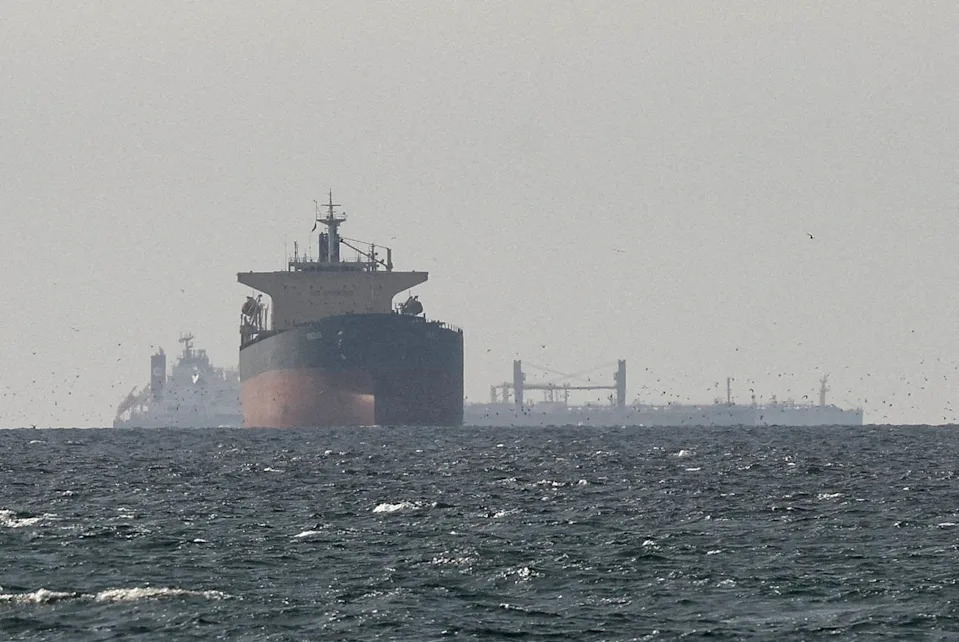
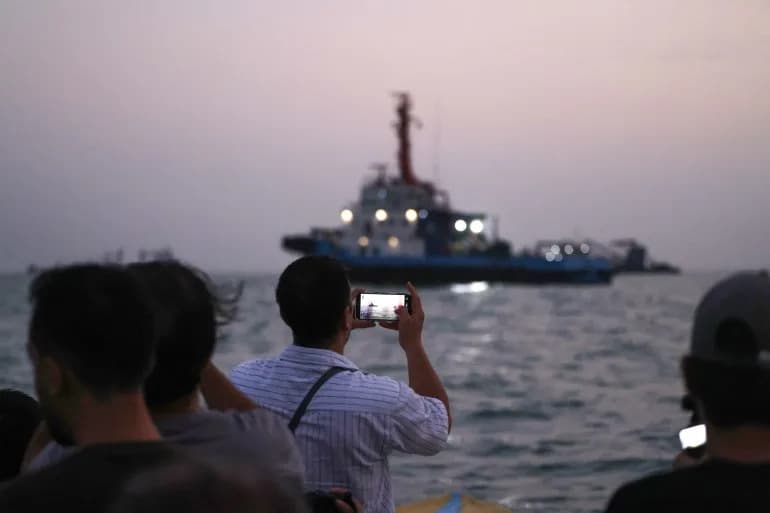
Iran’s chokehold on the Strait of Hormuz, a major shipping lane for global energy supplies, has rattled oil markets and pushed up prices. / Stringer/REUTERS
“The Strait of Hormuz will be completely closed and will not be opened until our destroyed power plants are rebuilt,” the Islamic Revolutionary Guard Corps (IRGC) said in a statement, Reuters reports.
Immediate Consequences
The standoff has already affected global energy markets. U.S. gasoline prices have surged by roughly 30% amid an Iranian blockade of the Strait of Hormuz, a strategic waterway that carries as much as one-fifth of the world’s oil supplies. Market observers warn that attacks on energy infrastructure could push prices higher for an extended period.
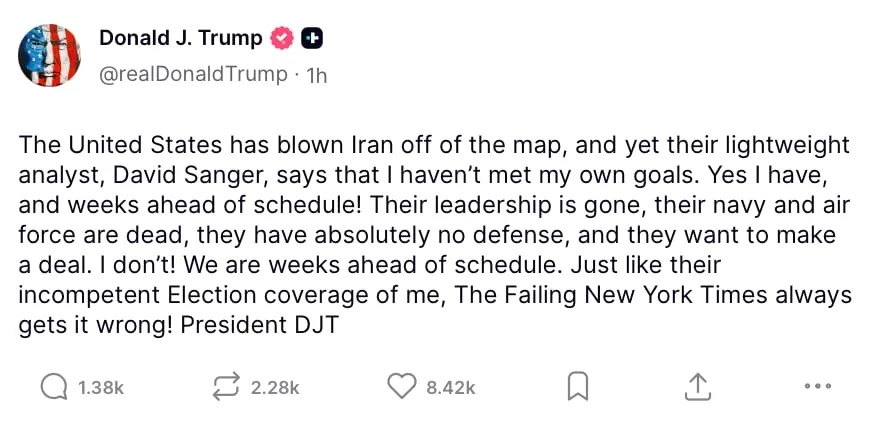
Trump claimed he had wiped Iran “off the map” before threatening new military strikes just an hour later. / Truth Social
Legal And Humanitarian Concerns
Legal experts note that deliberately targeting civilian infrastructure such as power plants can violate international humanitarian law. The Geneva Conventions prohibit attacks on “objects indispensable to the survival of the civilian population,” and strikes on power or desalination facilities could have devastating humanitarian effects — particularly in Gulf states that rely heavily on energy-intensive desalination for drinking water.
Wider Risks
Analysts say the exchange increases the risk that U.S. allies in the Middle East could be drawn deeper into the conflict and that tit‑for‑tat strikes on civilian systems would further destabilize markets and public services. The conflict has already resulted in U.S. and Iranian casualties; reporting cited in earlier coverage places the toll at 13 U.S. service members and more than 1,000 Iranian civilians, though figures vary by source.
Conflicting Messages
Observers also pointed to inconsistent messaging from the White House. The ultimatum followed remarks from Trump that the U.S. had “blown Iran off of the map” and that Tehran had “no defense,” comments he later contradicted with additional statements. The Daily Beast has reached out to the White House for comment; Reuters provided much of the reporting on Iran’s response.
Why it matters: The exchange underscores how public threats against civilian infrastructure can escalate conflicts quickly, carry legal and humanitarian risks, and produce immediate economic fallout through energy-market shocks.
Help us improve.