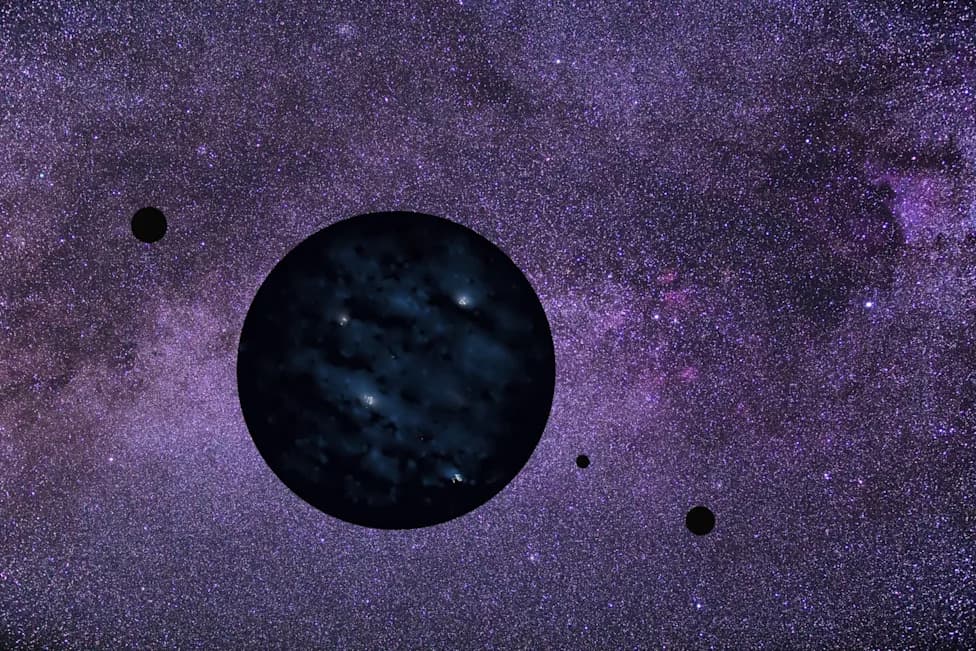
Moons orbiting free-floating (rogue) planets could sustain liquid water if internal tidal heating is paired with thick, hydrogen-rich atmospheres. Unlike CO2, which can condense and collapse at the pressures required, dense H2 atmospheres trap heat via collision-induced absorption (CIA), potentially maintaining temperate conditions for up to ~4.3 billion years. Models combining the HELIOS radiative-transfer code and GGchem chemistry support this scenario but rely on simplifying assumptions (constant gravity, dry atmospheres, layered equilibrium chemistry). Further work adding water vapor, clouds, and vertical transport is needed to test how robust these results are.
Lonely No More: Exomoons Around Rogue Planets Could Harbor Liquid Water for Billions of Years
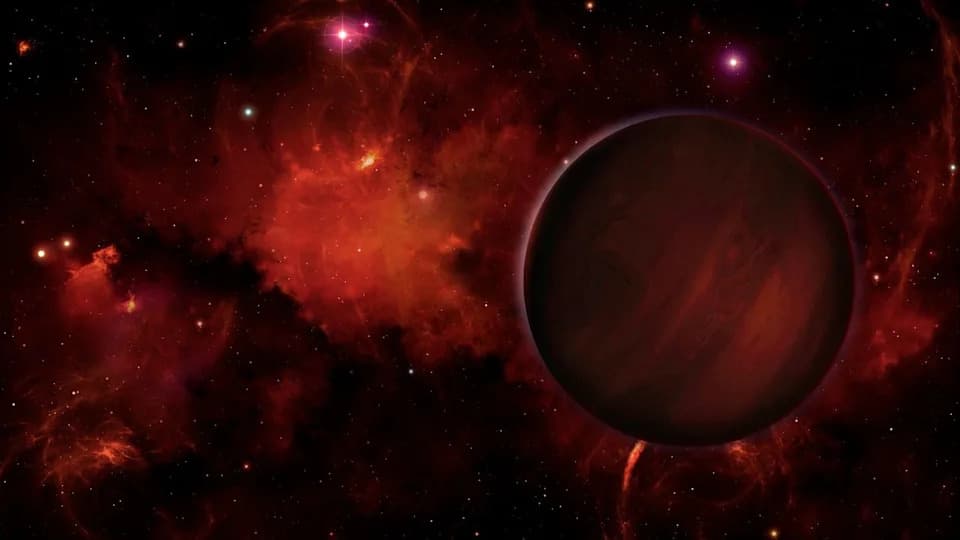
Illustration of a free-floating planet. These planets are odd in that, unlike most extrasolar objects, they do not seem to be in orbit around a star - they are free-floating planets drifting between the stars and galaxies. . | Credit: Mark Garlick/Science Photo Library/Getty Images
A cold world adrift in the dark between stars sounds utterly desolate — but recent models suggest that moons orbiting free-floating, or rogue, planets might be surprisingly hospitable. These planets do not orbit a star; they wander through interstellar space. Astronomers estimate there could be many such wanderers — some studies suggest as many as ~21 rogue planets per star in the Milky Way — implying a large, largely unexplored population of isolated worlds.
How Exomoons Can Stay Warm
When a planet is ejected from its natal system, any bound moons can experience dramatic changes in orbital eccentricity. Those repeated stretches and squeezes produce tidal heating: internal friction and deformation that act like a planetary furnace. Combined with an atmosphere that can trap heat, tidal heating could keep surface temperatures on an exomoon high enough for liquid water.
Why CO2 May Not Cut It
Earlier habitability scenarios focused on thick carbon dioxide (CO2) atmospheres as a thermal blanket to retain tidal heat. However, CO2 becomes problematic at the extreme pressures required: it can condense into liquid or solid phases and collapse out of the atmosphere, causing a runaway loss of greenhouse warming. That atmospheric collapse undermines long-term surface liquid water in many CO2-centric models.
Hydrogen As An Unexpected Insulator
Newer studies point to hydrogen-dominated atmospheres as a robust alternative. Although molecular hydrogen (H2) is not a conventional greenhouse gas, dense H2 atmospheres can trap infrared radiation through collision-induced absorption (CIA). When H2 molecules collide in a thick atmosphere they transiently form pairs that absorb infrared light, enabling efficient heat retention. Coupled with sustained tidal heating, CIA in massive hydrogen envelopes could maintain temperate surface conditions for geologically long periods — the models suggest up to about 4.3 billion years under favorable conditions.
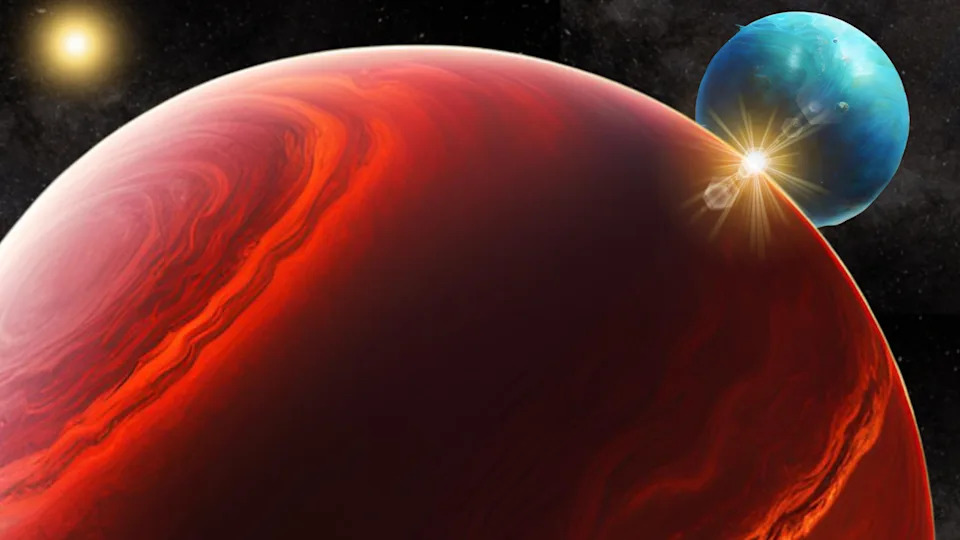
An illustration showing the gas giant planet HD 206893 B and its potential exomoon | Credit: Robert Lea (created with Canva)
How The Models Were Built
Researchers combined advanced computational tools to reach these conclusions. They used the HELIOS radiative-transfer code to model how radiation moves through and is absorbed by an atmosphere and GGchem to compute equilibrium condensation chemistry layer by layer. By tying tidal heating rates to atmospheric opacity and composition, the models produce a self-consistent picture of how a hydrogen-rich exomoon might remain warm without a host star.
Key caveat: these are theoretical models with important simplifying assumptions.
Model Limitations
- HELIOS assumes a constant gravity profile, which may be less accurate for low-gravity moons carrying extremely thick atmospheres.
- Current simulations typically model dry atmospheres, omitting the dynamical and radiative effects of water vapor, clouds, and condensation feedbacks.
- GGchem computes chemical equilibrium independently for each atmospheric layer and does not include vertical transport, mixing, or kinetic (non-equilibrium) chemistry.
Because of these approximations, the exact parameter space where long-term habitability is possible will shift as models add complexity. Nonetheless, the basic result — that tidal heating plus collision-induced absorption in thick hydrogen atmospheres can sustain liquid water for billions of years — is robust enough to motivate further study.
Implications And Next Steps
This work broadens the kinds of environments considered potentially habitable, expanding the search from planets in stellar habitable zones to a vast population of free-floating systems. Future research will need to incorporate water vapor and clouds, vertical mixing and non-equilibrium chemistry, and more realistic gravity profiles. Observationally, searching for signatures of massive atmospheres or thermal excess around isolated objects could help test these ideas.
Finally, liquid water is a necessary but not sufficient condition for life. While these models show promising avenues for habitability in the loneliest corners of the galaxy, whether such worlds ever develop or sustain life remains an open question — one worth exploring.
Help us improve.