
St. Susanna Parish in Dedham, Massachusetts, replaced the infant Jesus in its nativity with a sign reading “I.C.E. WAS HERE” and added a tip line to report immigration agents. The display continues the parish’s immigration‑themed mangers and drew criticism from the Archdiocese of Boston and conservative groups, while supporters say it highlights the Nativity’s refugee narrative. A widely cited 1,150% increase in assaults on ICE officers is disputed and lacks clear context. Advocates say dioceses should do more to support immigrant parishioners, many of whom are Latino and central to parish life.
Boston Parish’s Anti‑ICE Nativity — ‘I.C.E. WAS HERE’ Sign Reignites Debate Over Faith and Immigration
10:37 AM, 12/10/2025

Critics of this anti-ICE Boston nativity scene have totally missed the plot
St. Susanna Parish in Dedham, Massachusetts, has turned its annual nativity display into a pointed commentary on immigration enforcement: the usual infant Jesus was replaced with a sign reading “I.C.E. WAS HERE”, and the scene includes a phone number for people to report sightings of immigration agents. The installation continues a parish practice of immigration‑themed mangers; the 2018 display depicted the infant inside a cage.
The stark image is intended to provoke reflection. In a Sunday homily, Rev. Stephen Josoma said the nativity reminds people that new life is often found “out in the margins of life — out of the desert, the places that are not seen by society,” and he pointed to overcrowded shelters, detention centers and refugee camps as contemporary parallels.
The display drew swift criticism. The Archdiocese of Boston called it “divisive political messaging” that, in the archdiocese’s view, diminishes the sacred purpose of the nativity. C.J. Doyle of the Catholic Action League accused the priest of politicizing Christmas and staging what he called a political stunt.
Acting ICE director Todd Lyons condemned the display and cited a figure he attributes to ICE and the Department of Homeland Security — a reported 1,150% increase in assaults on ICE officers — to argue the installation contributes to a dangerous narrative.
That statistic, however, is contested in public discussion and lacks the context many observers say is needed. Critics point to several widely reported incidents — including clashes in which clergy and members of Congress were pepper‑sprayed and highly publicized enforcement encounters — and to judicial findings in unrelated cases that raised questions about some federal agents’ conduct. Because those examples are complex and fact‑specific, commentators say the raw percentage alone should be treated cautiously.
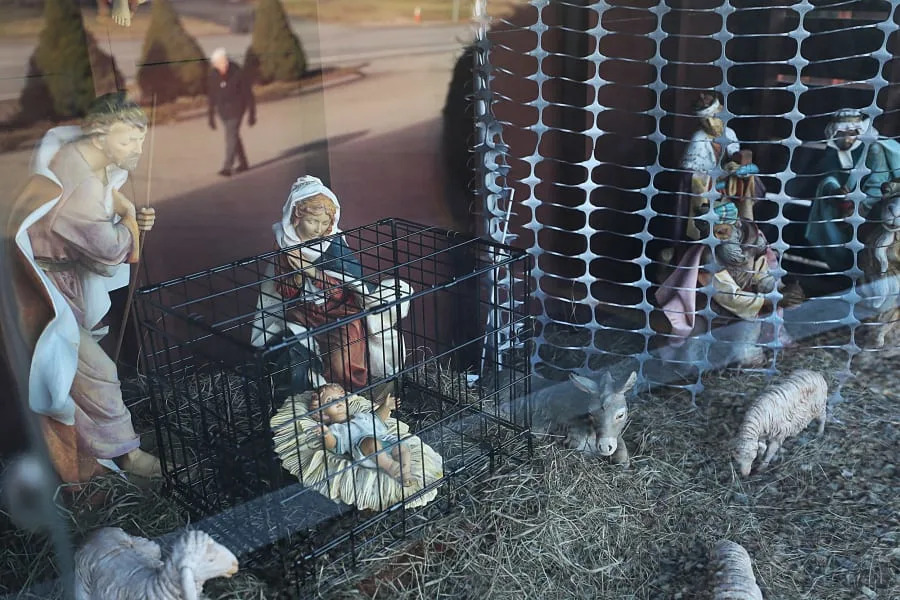
In 2018, the nativity scene at St. Susanna Parish in Dedham, M.A., included baby Jesus inside a black metal cage.Suzanne Kreiter/The Boston Globe via Getty Images
Supporters of St. Susanna, including parishioners and other faith leaders, argue the display calls attention to the Nativity’s often‑emphasized theme of flight and refuge: in their view, Jesus’ early story is a refugee story, and recognizing that parallel is consistent with the church’s social‑justice tradition. Other congregations have staged similarly provocative displays: Lake Street Church in Evanston, Illinois, showed Joseph and Mary in gas masks and the infant wrapped in the reflective blankets commonly issued to migrants in detention facilities.
Many Catholics and churchgoers say they want diocesan leaders to speak more boldly about immigration and the practical fears facing immigrant parishioners. Last month the United States Conference of Catholic Bishops urged compassion and warned of a growing climate of fear around profiling and immigration enforcement; the bishops said they oppose “indiscriminate mass deportation” and called for an end to dehumanizing rhetoric.
Public discussions of the nativity display have included an erroneous attribution in earlier coverage that mentioned a Pope Leo XIV quote. That attribution appears to be inaccurate and could not be verified; the quote has been removed from this version.
Latino Catholics represent a large and growing share of the U.S. Catholic population — frequently cited at roughly 40% — and many parish leaders say immigrant communities are vital to parish life and renewal. Supporters of St. Susanna argue the archdiocese should engage with these pastoral realities rather than simply condemning a parish for a provocative display.
Whether one finds the display moving or offensive, the episode has reignited a broader debate about the intersection of faith, public witness and immigration policy — and about how church leaders should respond when parishioners feel threatened by enforcement tactics and rhetoric.
Similar Articles

‘ICE Was Here’ Nativity At Boston-Area Church Sparks Condemnation From ICE And Archdiocese
Acting ICE Director Todd Lyons and the Archdiocese of Boston have demanded the removal of a sign reading "ICE was here" besid...

Operation Catahoula Crunch: New Orleans’ Sanctuary Policies Collide With Louisiana’s Pro‑Enforcement Push
Federal agents launched Operation Catahoula Crunch in Louisiana, pitting New Orleans’ sanctuary policy against state leaders ...

Approved Immigrants Pulled From Citizenship Line Moments Before Oath in Boston, Report Says
At a Dec. 4 naturalization ceremony in Boston, several immigrants who had already been approved for U.S. citizenship were pul...

Chicago Faith Leaders Mobilize to Resist ICE Raids and Support Detainees
Religious leaders across Chicago have organized weekly vigils, rapid‑response teams and mutual‑aid efforts in reaction to int...

Family Of Deported Babson Student Says ICE Agents Forced Open Gate At Their Austin Home
The family of 19-year-old Babson student Any Lucia López Belloza says immigration agents appeared at their Austin home after ...

New Analysis: High-Profile ICE Raids Mostly Detained People Without Criminal Records
Overview: A New York Times analysis of Deportation Data Project records through Oct. 15, 2025, finds that many high-profile I...

‘We’ll Need to See a Warrant’: How Businesses Are Using the Fourth Amendment to Push Back Against ICE
Siembra, an immigrant-rights group in North Carolina, is training businesses to invoke Fourth Amendment protections when ICE ...

ICE 'Operation Metro Surge' Detains About a Dozen Criminal Noncitizens in Minneapolis, Including Several Somali Nationals
ICE says it detained at least a dozen noncitizens in Minneapolis during 'Operation Metro Surge,' beginning Dec. 1, targeting ...

New ICE Records Show Nearly 75,000 People Arrested Without Criminal Records
Internal ICE records obtained by UC Berkeley’s Deportation Data Project show that nearly 75,000 of about 220,000 arrests from...

Federal Immigration Sweep Empties Kenner’s Hispanic Businesses, Residents Say Fear and Loss Linger
The article reports that a federal immigration operation called Catahoula Crunch has led to emptied Hispanic-owned restaurant...

After DC Shooting, Trump Escalates Anti-Immigrant Rhetoric — Calls Somalis 'Garbage' as Visa and Asylum Pauses Follow
President Trump and senior officials sharply escalated anti-immigrant rhetoric after an Afghan man was named a suspect in a W...

Records: Authorities Monitored Online Reaction During New Orleans 'Catahoula Crunch' Immigration Sweep
Records obtained by The Associated Press show state and federal agencies monitored online discussion and protests during the ...

ICE Raid in Burnsville Detains Four; Couple's 7-Year-Old Left Without Parents, Family Says
ICE agents arrested four people during a raid at a Burnsville, Minnesota, home, and family members say a couple's 7-year-old ...

More Than 1.4 Million Watched a TikTok of U.S. Catholic Bishops' Rare Special Message on Immigration
The TikTok clip of U.S. Catholic bishops has surpassed 1.4 million views. For the first time in 12 years , the bishops releas...

Hundreds Rally in Astoria After 6-Year-Old Is Placed in ORR Custody Following ICE Check-In
More than 200 people rallied in Astoria, Queens, after Fei Zheng was detained following a Nov. 26 ICE check-in and his 6-year...