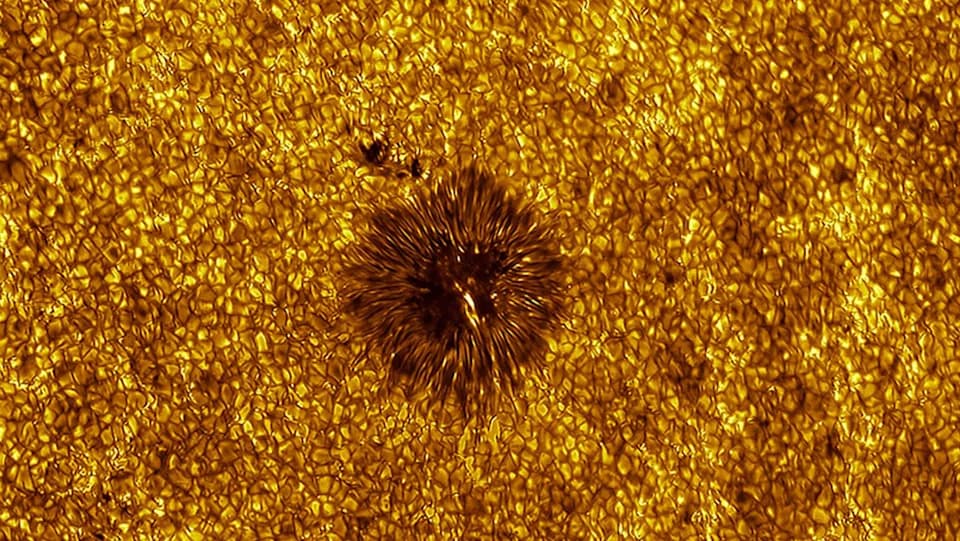
International researchers using the Daniel K. Inouye Solar Telescope captured the clearest images yet of the Sun's photosphere, revealing small whirlpool-like vortices caused by Kelvin–Helmholtz instability. Observations at 416 nm with ~19 km spatial resolution show deformed magnetic boundaries and ultra-fine stripes linked to the instability. Comparison with advanced simulations found dozens of matching vortex structures, marking the first experimental confirmation of KHI in the photosphere. Scientists will use automated analysis of DKIST data to determine how much these vortices contribute to coronal heating and energetic solar events.
Stunning DKIST Images Reveal Whirlpool-Like Vortices on the Sun's Surface
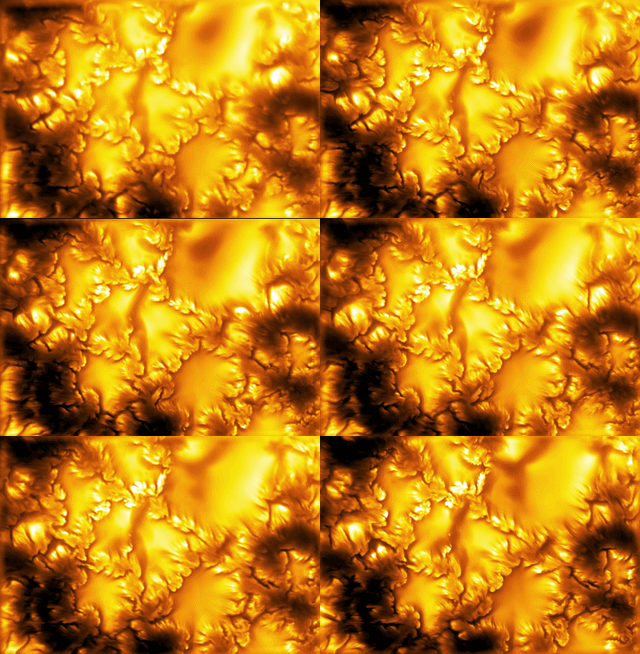
The highest-resolution image of the Sun's surface (photosphere) ever captured, taken at 416 nm by the Inouye Solar Telescope. It reveals deformed boundaries of magnetic elements and ultra-fine scale stripes, both associated with Kelvin-Helmholtz instability. (Credit: NSF/NSO/AURA/MPS)
Stunning new observations from the U.S. National Science Foundation's Daniel K. Inouye Solar Telescope (DKIST) reveal small, whirlpool-like vortices sweeping across the Sun's visible surface. These high-resolution images mark the first clear experimental detection of Kelvin–Helmholtz instability (KHI) in the solar photosphere and offer fresh clues about how energy and magnetic fields move through the Sun's atmosphere.
Record-breaking images: The DKIST observations include the highest-resolution photospheric image yet taken at 416 nm with an unprecedented spatial resolution of roughly 19 km. The images show deformed boundaries of magnetic elements and ultra-fine stripe patterns associated with shear-driven instabilities. (Image credit: NSF/NSO/AURA/MPS)
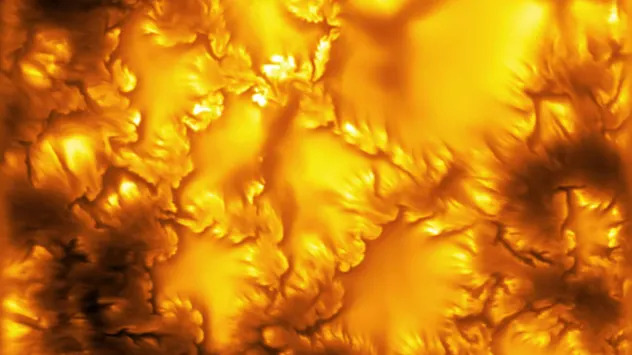
The highest-resolution image of the Sun's surface (photosphere) ever captured, taken at 416 nm by the Inouye Solar Telescope. It reveals deformed boundaries of magnetic elements and ultra-fine scale stripes, both associated with Kelvin-Helmholtz instability. (Credit: NSF/NSO/AURA/MPS)
What the team found: International researchers operating DKIST on Maui, Hawaii, captured dynamic swirls at the edges of magnetic regions in the photosphere. These vortexlike features are consistent with Kelvin–Helmholtz instability, which arises when two plasma layers slide past each other at different velocities and small perturbations grow into rolling vortices—analogous to the billowing crests seen in breaking ocean waves.
"We believe that the discovery of Kelvin-Helmholtz instability in the solar photosphere is a major step forward in our understanding of the dynamics and evolution of solar and stellar plasma, and will serve as a basis for future discoveries," said Dr. David Boboltz, Deputy Director at the National Solar Observatory.
Why it matters: The swirling motions could transport energy upward from the photosphere and contribute to heating the Sun's outer atmosphere, the corona. Researchers also propose that these vortices may concentrate or release free magnetic energy, potentially helping to trigger energetic events such as solar flares and coronal mass ejections (CMEs). Such events can affect satellites, power grids, GPS and other infrastructure on Earth and drive dramatic auroral displays.
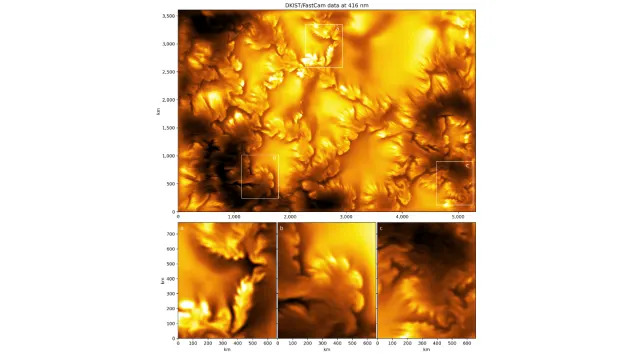
An image of the solar surface captured by the Inouye Solar Telescope at an unprecedented spatial resolution of ~19 km. Zoomed-in panels reveal the first observations of Kelvin–Helmholtz instability patterns at the solar surface. (Credit: NSF/NSO/AURA/MPS)
Confirming the theory with simulations: In a paper published in Nature, the team compared DKIST observations with advanced computer simulations of the photosphere. Dozens of similar vortex structures appeared in both the data and simulations, strengthening the case that the Sun's surface conditions naturally generate KHI at small scales.
Next steps: Scientists plan to deploy automated detection algorithms and analyze more DKIST data to quantify how much these whirlpools contribute to coronal heating and magnetic-field evolution. This work aims to clarify the role of small-scale instabilities in building magnetic energy and driving larger-scale solar activity.
Help us improve.