A near-Earth object discovered in 1998 and long catalogued as asteroid 1998 SH2 has been reclassified as the faint, active comet P/1998 SH2. A close August 2025 approach revealed small positional discrepancies; decades of precise astrometry showed nongravitational accelerations consistent with outgassing, and follow-up imaging with the VLT and CFHT confirmed a faint tail. The reclassification improves orbit prediction and highlights how subtle orbital changes can reveal hidden comets important to planetary defence.
Nearly 30 Years Later, Asteroid 1998 SH2 Revealed As Faint Comet P/1998 SH2
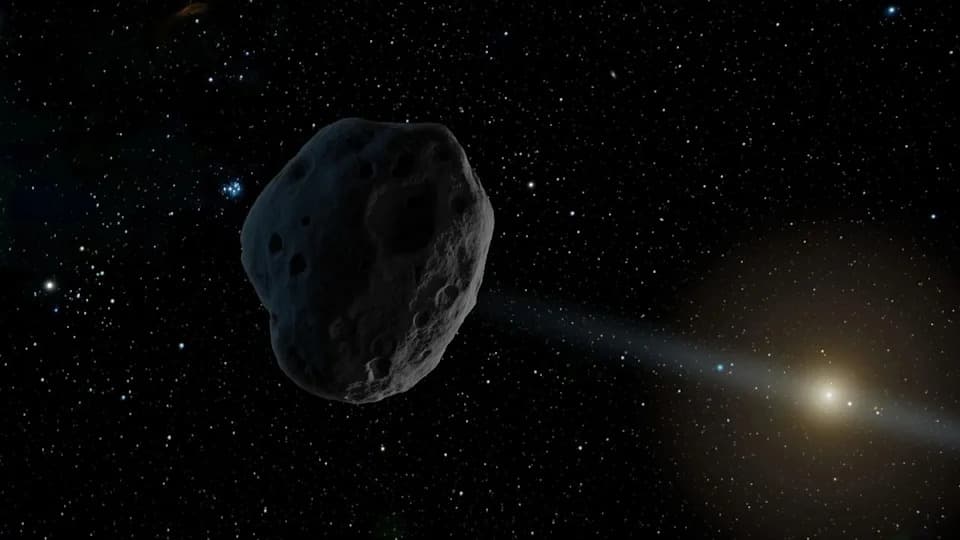
An illustration of a near-Earth asteroid like the 1998 SH2, which turned out to be a comet. | Credit: NASA/JPL-Caltech
A near-Earth object long catalogued as an asteroid has been reclassified as a faint, active comet after precision measurements revealed tiny forces tugging it off its predicted orbit. The object, discovered in 1998 as 1998 SH2, now also carries the cometary designation P/1998 SH2, a change with direct implications for how scientists track and assess impact risks from small bodies.
How the Misidentification Was Uncovered
During a close approach to Earth in August 2025 the object passed at roughly 2 million miles (≈3.2 million km). Radar observations from NASA's Deep Space Network showed the object was not exactly where orbital predictions expected it to be, prompting a detailed re-examination of its motion.
Researchers combined decades of high-precision optical astrometry — repeated measurements of the object's position against background stars — and found that gravity alone could not explain the small but persistent deviations. The team detected nongravitational accelerations consistent with jets of gas being expelled as subsurface ice warmed in sunlight. Such outgassing produces tiny thruster-like pushes that subtly alter a comet's trajectory over time.
"After we measured the nongravitational perturbations affecting the motion of 1998 SH2 and recognized they weren't compatible with the object being an asteroid, we suspected the object could be an active comet," said Davide Farnocchia, lead author of the study and a navigation engineer at NASA's Center for Near-Earth Object Studies at the Jet Propulsion Laboratory.
Confirmation and Designation
To test the hypothesis, astronomers imaged the object with the European Southern Observatory's Very Large Telescope in Chile and the Canada–France–Hawaii Telescope on Mauna Kea. The observations revealed a faint but unmistakable cometary tail, confirming active outgassing and leading to the official cometary designation P/1998 SH2.
Why This Matters For Planetary Defence
Unlike inert rocky asteroids, comets can experience ongoing trajectory changes from outgassing. Detecting those nongravitational forces allows scientists to refine long-term orbit predictions and more accurately assess any potential impact threat. The discovery demonstrates that precise astrometric tracking can reveal "hidden" comets that lack obvious comae or tails in routine surveys.
The researchers note that as astrometric measurements become ever more precise, additional near-Earth objects currently classified as asteroids may be revealed as weakly active comets. Identifying those objects early improves orbit forecasts and helps prioritize follow-up observations and risk mitigation planning.
Publication: The team’s findings were published on July 10 in the journal Nature Astronomy.
Help us improve.