The James Webb Space Telescope has allowed astronomers to identify the stellar sources of dust in the metal-poor dwarf galaxy Sextans A, a close analogue of early galaxies. JWST’s NIRCam and MIRI mapped the galaxy’s asymptotic giant branch (AGB) stars and found that about 90% lacked dust envelopes while ~20 were enshrouded in thick dust shells. These dusty AGB stars formed 2–3 billion years ago from ~1.5 solar-mass progenitors and are likely key contributors to early cosmic dust enrichment.
JWST Reveals ‘Dust Factories’ in Nearby Dwarf Galaxy That Mirror the Early Universe
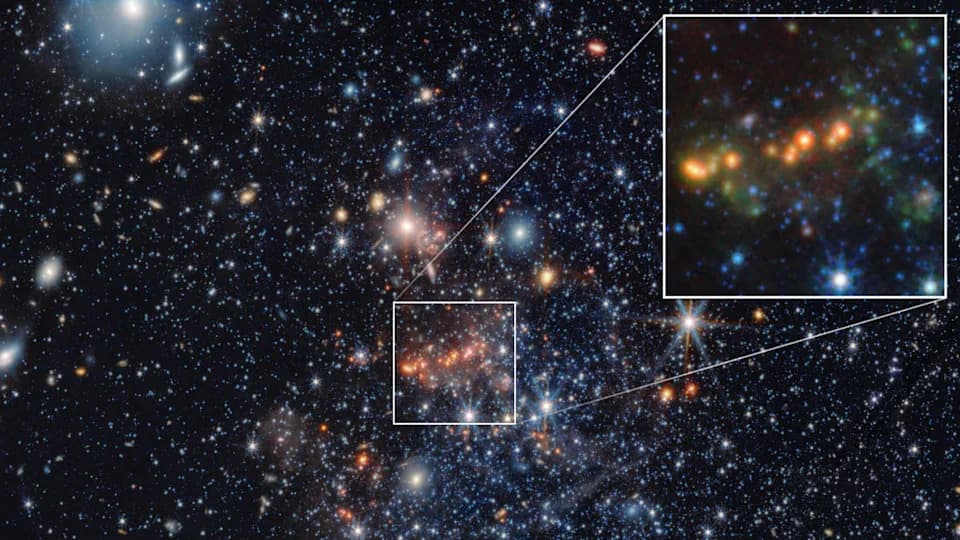
The dwarf galaxy Sextans A observed by the James Webb Space Telescope. | Credit: NASA, ESA, CSA, STScI, Janice Lee (NOIRLab). Image processing: Alyssa Pagan (STScI).
Using the James Webb Space Telescope (JWST), astronomers have identified how metal-poor galaxies produced the dust that later became essential for star formation and galaxy growth. By studying the nearby dwarf galaxy Sextans A — a modern analogue for the universe’s earliest systems — researchers mapped a population of evolved stars and identified the likely stellar sources of that dust.
Target and Rationale. Sextans A lies about 4.6 million light-years away in the Local Group and is extremely metal-poor, containing roughly 1%–7% of the Sun’s heavy elements. Because its chemical composition resembles conditions in the early cosmos, Sextans A offers a rare laboratory for studying processes that were difficult to observe directly in the infant universe.
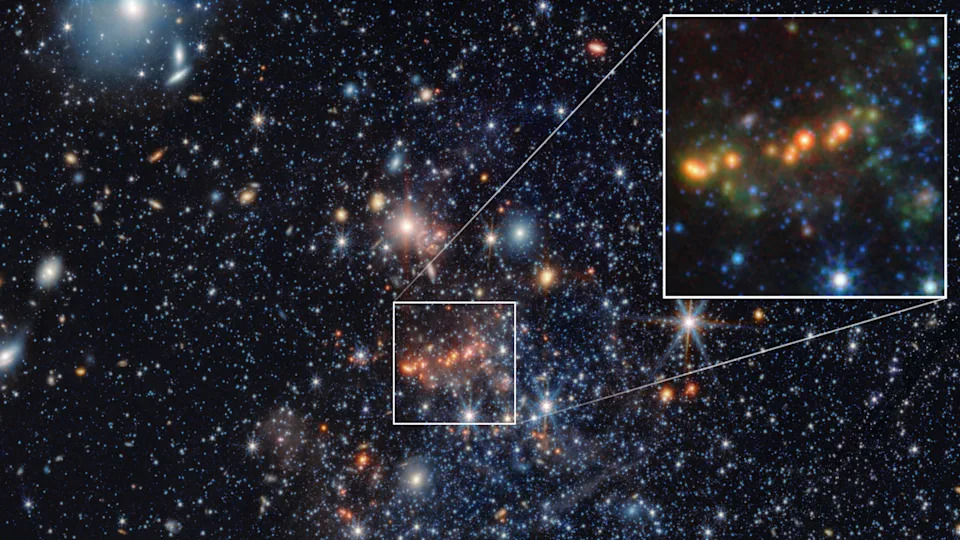
The dwarf galaxy Sextans A observed by the James Webb Space Telescope. | Credit: NASA, ESA, CSA, STScI, Janice Lee (NOIRLab). Image processing: Alyssa Pagan (STScI).
Observations and Methods. The team used JWST’s Near-Infrared Camera (NIRCam) and Mid-Infrared Instrument (MIRI) to obtain high-resolution imaging of Sextans A. These instruments allowed researchers to identify and characterize the galaxy’s population of asymptotic giant branch (AGB) stars — a late evolutionary phase during which stars expand, can brighten dramatically, and sometimes produce dust in their outer envelopes.
Key Findings. The study found that about 90% of the observed AGB stars in Sextans A lacked significant dusty envelopes. However, roughly 20 AGB stars were enshrouded in thick dust shells. Modeling of these objects indicates they formed 2–3 billion years ago from progenitors with initial masses of about 1.5 times the mass of the Sun. These dusty AGB stars are efficient "dust factories" that can inject newly produced heavy elements and grains into the interstellar medium.
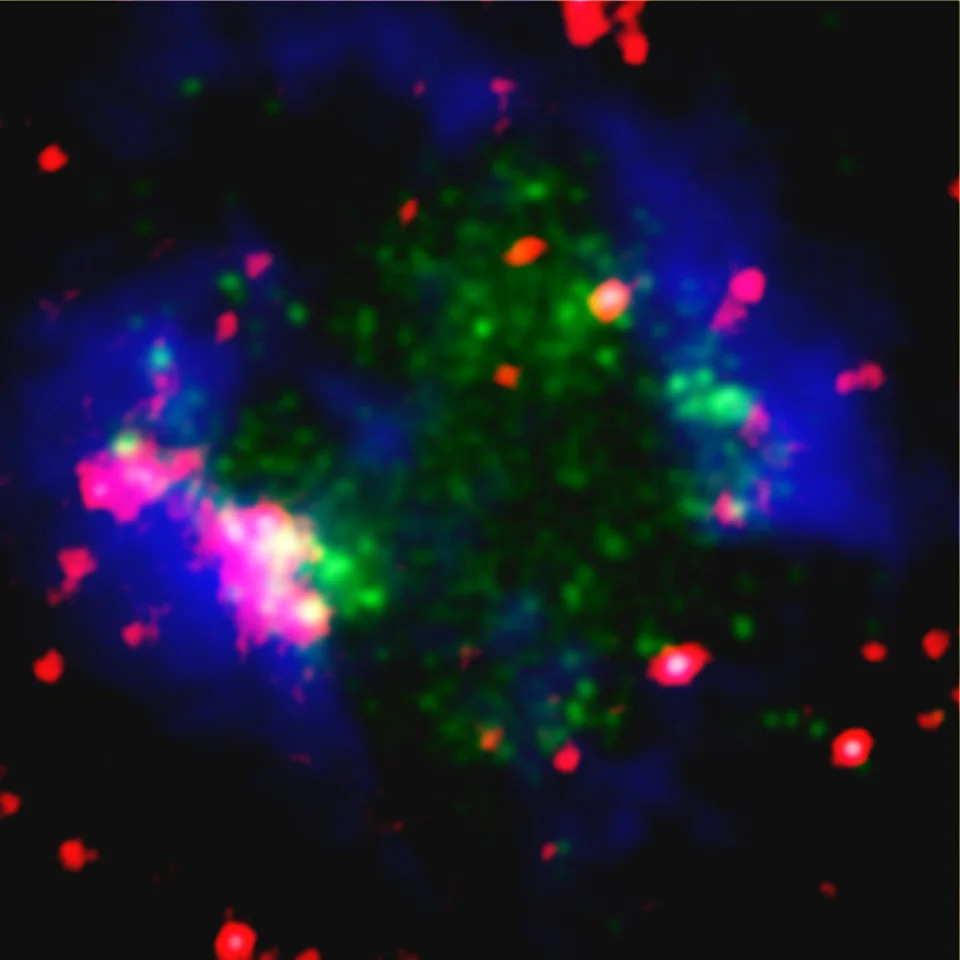
An image of the galaxy Sextans A where Red indicates the infrared emission of dust, blue the emission of atomic hydrogen gas, and green the far-ultraviolet emission created by newly formed stars. | Credit: Yong Shi
Why This Matters. The results help clarify which stellar populations were most effective at enriching the early universe with metals and dust. That enrichment is a crucial step toward cooling gas clouds and enabling subsequent generations of star formation, ultimately shaping the galaxies we observe today.
“Directly studying the galaxies that populated the early universe is still very difficult, which is why observing a nearby galaxy like Sextans A, which presents similar chemical conditions, offers us a precious opportunity to understand how the first generations of stars evolved,” said Claudio Gavetti of the National Institute for Astrophysics (INAF).
Team member Flavia Dell'Agli added: “JWST allows us to observe in unprecedented detail environments that until a few years ago were beyond our reach. The real value lies in comparing these observations with theoretical models to test how well they describe stellar evolution and dust production.”
Publication. The study was published on July 20 in The Astrophysical Journal.
Image credit: NASA, ESA, CSA, STScI, Janice Lee (NOIRLab). Image processing: Alyssa Pagan (STScI).
Help us improve.