The Israel Antiquities Authority has opened a window into deep prehistory with the excavation of a remarkably well-preserved cave near Fureidis, south of Haifa, dated to 400,000–250,000 years ago and linked to the Acheulo-Yabrudian complex. Finds include bones of fallow deer, gazelle and ancient horses, evidence of nearby water, and an expected rich assemblage of advanced flint tools. The site offers rare, high-resolution insight into prolonged occupations, fire use and emerging social complexity; researchers plan an extensive study and hope to open the site to the public.
Rare Paleolithic 'Time Capsule' Discovered Near Haifa — Cave Dates to 400,000–250,000 Years Ago
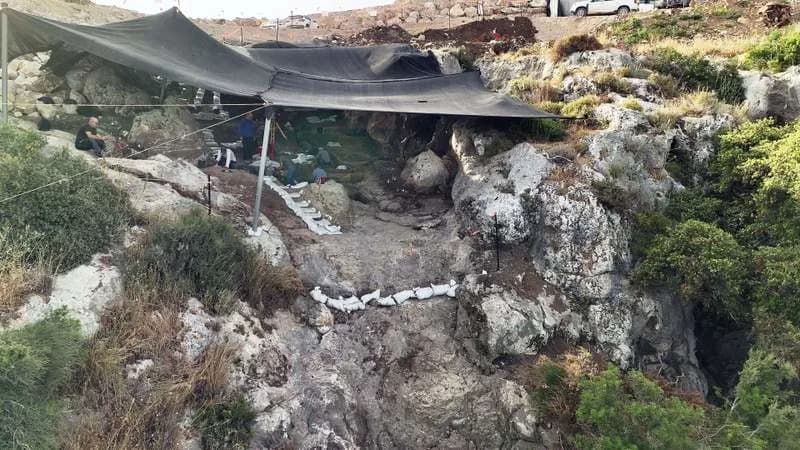
Cave from Lower Paleolithic era found south of Haifa, June 11, 2026. (photo credit: EMIL ALADJEM/ISRAEL ANTIQUITIES AUTHORITY)
Archaeologists have begun excavating an exceptionally well-preserved Paleolithic cave on the outskirts of Fureidis, south of Haifa near the Zichron Ya'acov interchange, the Israel Antiquities Authority (IAA) announced. The excavation is funded by Ayalon Highways Company and led by Dr. Kobi Vardi and Amit Gabbay of the IAA’s Prehistory Branch, in collaboration with Professor Ron Shimelmitz of the University of Haifa.
Based on stratigraphy and material remains, researchers date the cave’s occupations to between roughly 400,000 and 250,000 years ago, placing it within the Acheulo-Yabrudian cultural complex at the close of the Lower Paleolithic in the Levant.
Key Finds
Excavators have recovered animal bones identified as fallow deer, gazelle and ancient horses, along with sedimentary evidence for nearby water sources that likely made the site attractive to mobile hunter-gatherer groups. The team expects to recover a diverse flint assemblage characteristic of the Acheulo-Yabrudian — including fine, small handaxes, scrapers and blades produced with advanced knapping techniques.
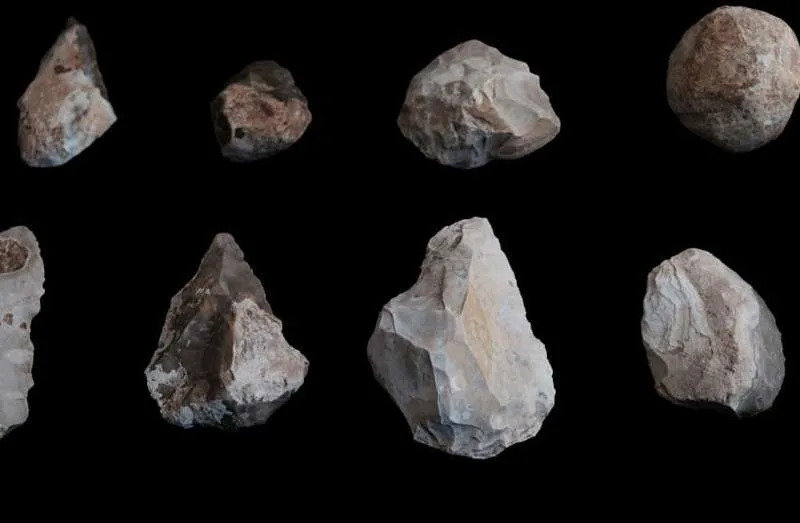
Prehistoric handaxes discovered in the ancient cave found near Haifa, June 11, 2026. (credit: EMIL ALADJEM/ISRAEL ANTIQUITIES AUTHORITY)
Significance and Next Steps
Researchers describe the site as a rare "time capsule" that can provide unusually high-resolution information about life at a pivotal stage in human evolution: a period that prefigures later behavioral complexity in both Neanderthals and anatomically modern humans. Professor Shimelmitz noted that Acheulo-Yabrudian deposits often show longer site occupations, evidence of sustained fire use and indicators of increasing social cooperation and knowledge transmission.
"It is very rare to find a site in such a state of preservation," said Dr. Kobi Vardi. "Every prehistorian who visits the site is absolutely thrilled."
Following the initial discoveries, the IAA and the University of Haifa plan a large-scale research program to reconstruct how prehistoric people lived, adapted to environmental change, and developed new technologies. The team hopes the site will eventually be made accessible to the public, including nearby residents and schoolchildren.
Related Discoveries
In a related development, researchers from Tel Aviv University reported hundreds of large, carefully made Pleistocene handaxes in the Sakhnin Valley (Lower Galilee). First brought to attention by local resident Muataz Shalata, the collection — likely produced by Homo erectus — underscores the region's long history as a focal point of human activity and tool making.
The combined discoveries in Fureidis and the Sakhnin Valley promise new insights into early human technology, mobility and social organization across the Levant during the Middle to Late Lower Paleolithic.
Help us improve.