Pitchford v. Cain (5–4) found that Mississippi courts violated Batson by allowing prosecutors to strike Black jurors and then denying the defense a chance to rebut the prosecution’s race‑neutral explanations. Justice Brett Kavanaugh wrote the opinion, joined by Chief Justice John Roberts and the three liberal justices. The ruling was narrow and procedural—likely to lead to further proceedings or a new trial—but it reinforces that courts must complete Batson’s three‑step inquiry. The decision also highlights the Court’s uneven approach to recognizing racial bias across different legal contexts.
Kavanaugh and Roberts Side With Batson in Pitchford v. Cain — A Narrow Win Against Racial Jury Strikes
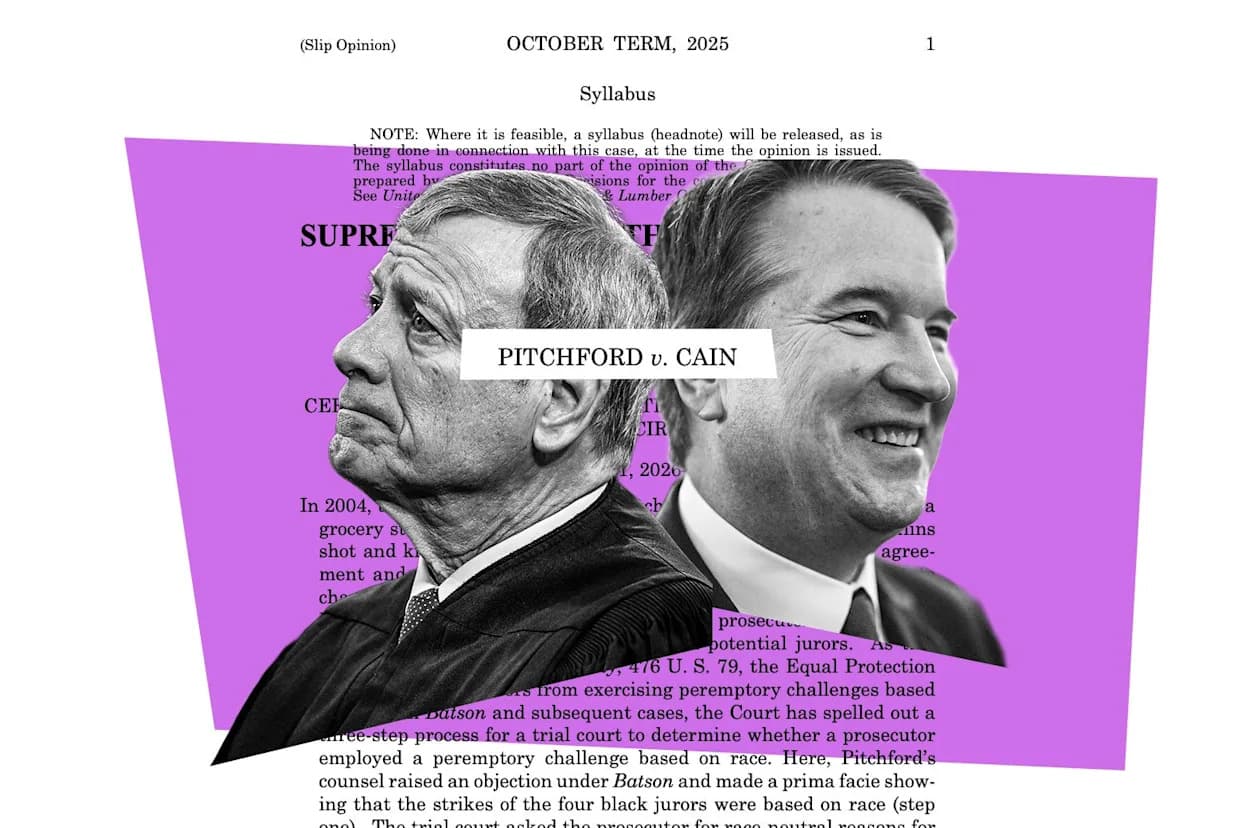
The Supreme Court on Thursday issued a narrowly focused but significant ruling in Pitchford v. Cain, finding that Mississippi courts violated the Constitution by permitting prosecutors to strike Black jurors and then denying the defense an opportunity to challenge those strikes. Justice Brett Kavanaugh wrote the 5–4 opinion, joined by Chief Justice John Roberts and the court’s three liberal justices.
Case Background
Terry Pitchford, 18 at the time of the events, participated in the 2004 robbery of a Mississippi grocery store. Another teenager, Eric Bullins (16), allegedly fired the shot that killed the white store owner; Bullins later accepted a plea deal and received a 20‑year sentence. Pitchford, who prosecutors say did not fire the fatal shot, was tried separately and faced a capital murder charge.
What Went Wrong In Jury Selection
Jury selection can be decisive in racially charged criminal trials. Under Batson v. Kentucky (1986), the Fourteenth Amendment forbids prosecutors from using peremptory strikes to exclude jurors because of race. Batson established a three‑step inquiry: (1) the defense objects to a strike as racially motivated; (2) the prosecution offers race‑neutral reasons; and (3) the defense is given an opportunity to rebut those reasons as pretextual.
At Pitchford’s trial, Mississippi prosecutor Doug Evans used most of his peremptory strikes to remove four of five Black prospective jurors. When Pitchford’s counsel raised a Batson objection and Evans offered so‑called race‑neutral explanations, trial judge Joseph Loper accepted the prosecution’s rationales but then cut off the defense—allowing the first two steps of Batson but denying the third. The defense never had a real chance to rebut the prosecution’s proffered reasons.
The Supreme Court’s Reasoning
Kavanaugh’s short majority opinion emphasized the procedural error: Batson requires all three steps, and the trial court’s truncation of the process was reversible error. The Mississippi Supreme Court and the U.S. Court of Appeals for the Fifth Circuit had previously held that the Batson objection was waived, but the High Court found that counsel had attempted to raise the objection and was effectively silenced by the trial judge.
Context And History
This decision echoes Kavanaugh’s earlier engagement with Batson issues. As a law student he urged robust Batson hearings, and in 2019 he authored the majority opinion in Flowers v. Mississippi—also criticizing the same prosecutor, Doug Evans, and the same judge, Joseph Loper, after multiple trials in which Black prospective jurors were disproportionately struck. That history likely informed the Court’s skepticism of the prosecution’s explanations in Pitchford.
Why This Ruling Matters — And Its Limits
The opinion is narrow and procedural: it identifies a Batson violation but does not itself vacate Pitchford’s death sentence. Historically, however, similar rulings have led to retrials or dismissal of charges; in Flowers, prosecutors eventually dropped the case after repeated reversals. The majority here signaled that the appropriate remedy for the fundamental prejudice created by the truncated Batson hearing would likely be a new trial.
Broader Implications
Although Kavanaugh and Roberts deserve credit for enforcing Batson in this instance, the decision highlights a recurring inconsistency: both justices have often been reluctant to recognize racial discrimination in other areas of law. Their willingness to find a Batson violation here — against an arguably unsympathetic defendant and an evidently clumsy prosecutor — suggests the Court will acknowledge clear, low‑cost examples of discrimination but remains selective when recognition would carry heavier doctrinal consequences.
Bottom line: Pitchford v. Cain is an important enforcement of Batson’s procedural protections, reiterating that courts must allow the full three‑step inquiry when race is at issue in juror strikes. Its narrowness, however, underscores that broader change on racial justice issues will require a consistent willingness from the Court to confront discrimination across contexts.
Help us improve.