Asteroid 2026 JH2, about 115 feet (35 m) across, will pass roughly 56,000 miles (91,000 km) above Earth at about 6 p.m. EDT on Monday, May 18. Traveling near 20,000 mph (32,000 km/h), it should reach about magnitude 11.5, visible with a good amateur telescope or strong binoculars. There is zero chance of impact during this flyby; the Virtual Telescope Project will livestream the event.
Blue-Whale–Sized Asteroid 2026 JH2 to Zoom Past Earth Monday — Visible With Telescopes and Live Stream
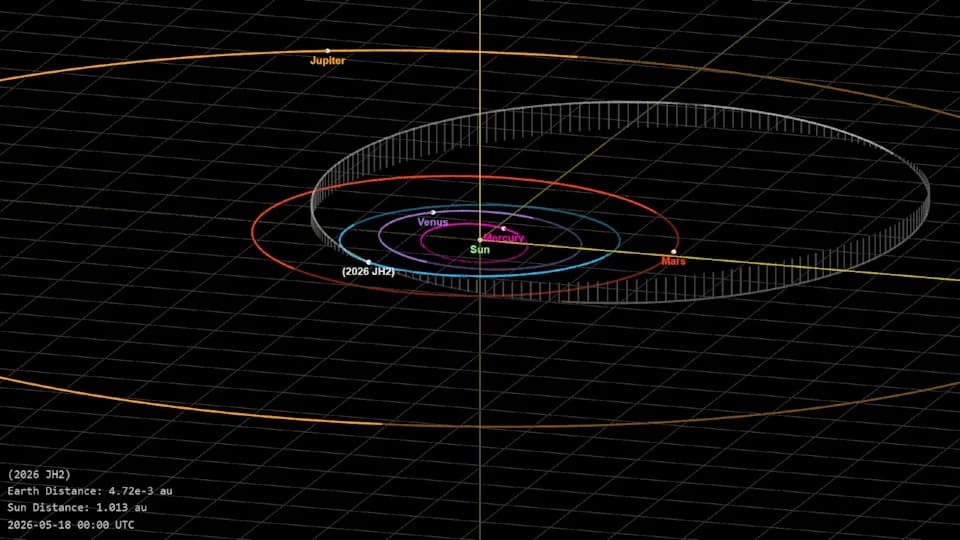
2026 JH2 has circles the sun every 3.7 years on a highly elliptical orbit between Earth and Jupiter. | Credit: NASA/JPL/Small-Body Database Lookup
A previously undiscovered asteroid roughly the length of a blue whale will pass unusually close to Earth on Monday, May 18. Designated 2026 JH2, the space rock was discovered on May 10 by astronomers at Mount Lemmon Observatory and has since been confirmed by follow-up observations worldwide.
What We Know
2026 JH2 is estimated to be up to 115 feet (35 meters) across — comparable in size to the Chelyabinsk meteor that exploded over Russia in 2013. It travels at about 20,000 mph (32,000 km/h) and follows an elliptical orbit around the Sun with a period of roughly 3.7 years, taking it as far out as Jupiter.
The asteroid's closest approach is expected at about 6:00 p.m. EDT on Monday, May 18, when it will pass at an altitude near 56,000 miles (91,000 km) — roughly one quarter of the distance to the Moon. At that distance it will be nearer to Earth than a small number of spacecraft (including TESS), though scientists say there is no danger to satellites or to the planet. Limited observation time creates some uncertainty in the exact distance, but researchers stress there is zero chance of impact during this flyby.
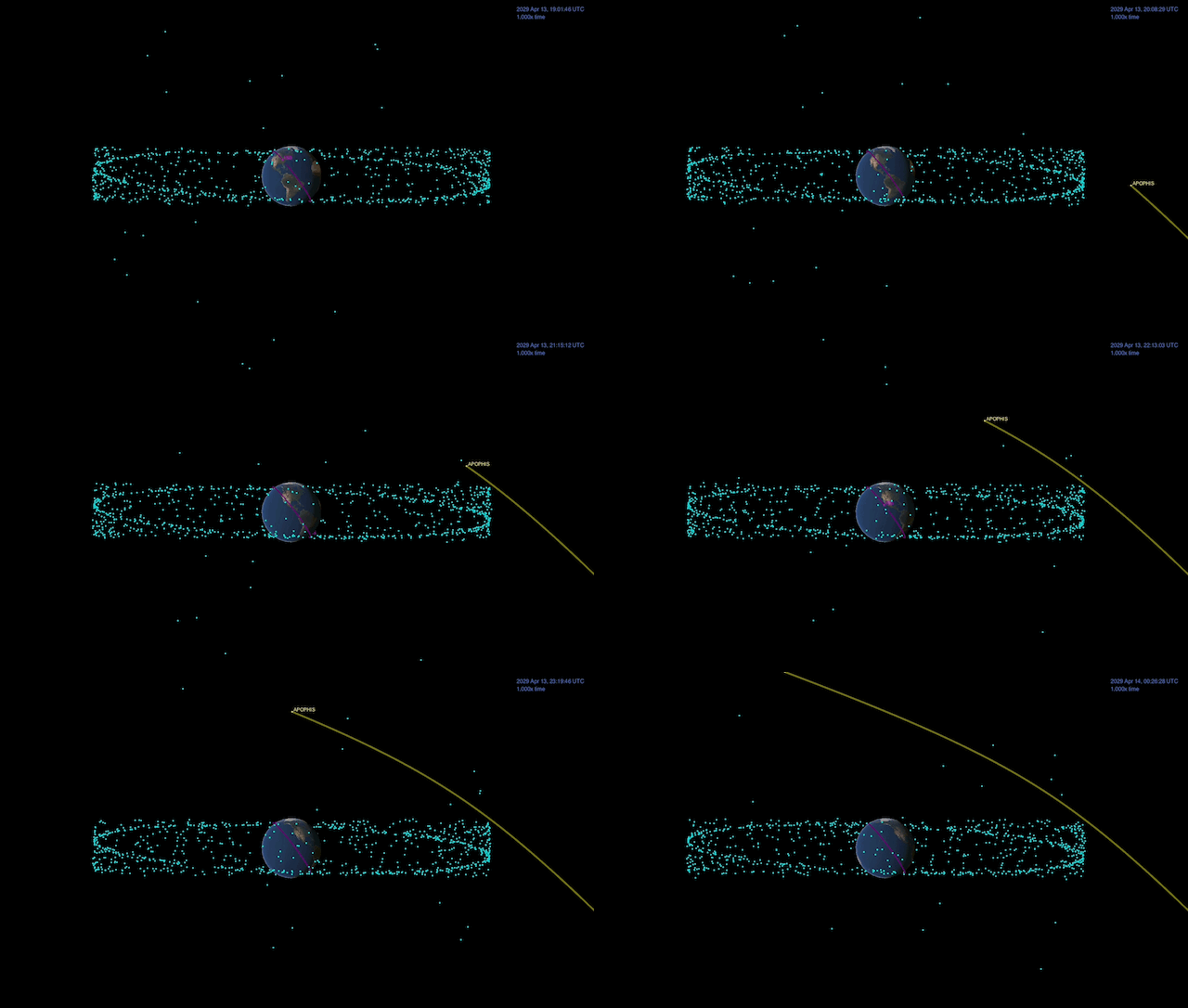
2026 JH2 will come closer to Earth than some satellites, similar to the "God of Chaos" asteroid Apophis (shown in this simulation). | Credit: NASA/JPL
How To See It
Near its closest approach 2026 JH2 should reach about magnitude 11.5, making it a good target for a quality amateur telescope or steady stargazing binoculars under dark skies. For live tracking and up-to-date sky coordinates, consult resources such as TheSkyLive.com.
If you prefer to watch online, the Virtual Telescope Project (run by astronomer Gianluca Masi) will stream the flyby live from a telescope in Manciano, Italy.
Context And Why It Matters
Encounters at this scale are rare: objects the size of 2026 JH2 seldom pass this close to Earth. Smaller meteoroids strike Earth's atmosphere frequently and produce visible fireballs; events like this highlight the value of finding and tracking near-Earth objects so scientists can assess and mitigate potential future risks.
Looking ahead, larger objects are scheduled for close approaches in coming years: 99942 Apophis (about 340 meters across) will pass within roughly 20,000 miles (32,000 km) on April 13, 2029 and will be intensively monitored, and asteroid 2024 YR4 is expected to pass near the Moon in 2032. Current calculations indicate none of these objects pose an imminent impact threat, but continued observations refine predictions and reduce uncertainty.
Bottom line: 2026 JH2 will offer a rare, close view of a blue-whale–sized asteroid with no impact risk — watch it with a good telescope or via the Virtual Telescope Project livestream.
Help us improve.