The University of California, Riverside-led team used the James Webb Space Telescope to create the most detailed map yet of the cosmic web, revealing the network of dark matter, diffuse gas and filaments that connect galaxies and clusters. Webb’s depth and resolution expose structures from a few hundred million years after the Big Bang that were previously blended together. The results, published in The Astrophysical Journal, enable new studies of how environment influences galaxy evolution from early times to the nearby universe.
JWST Produces Most Detailed Map Yet of the Cosmic Web
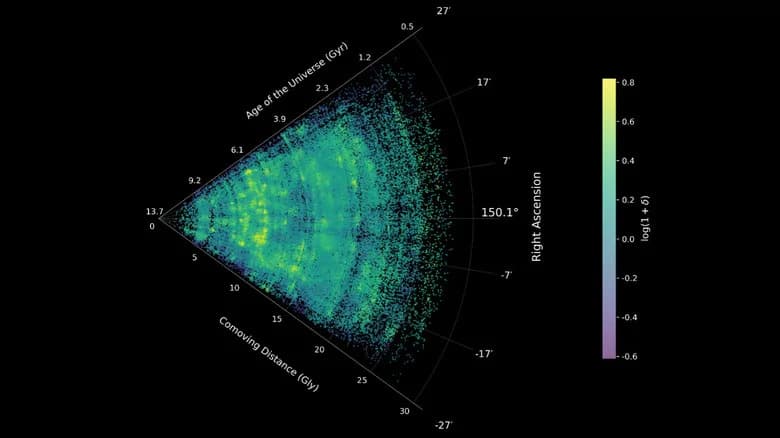
A slice through the COSMOS-Web cosmic-web map, showing galaxies across nearly 14 billion years of cosmic history. - UCR/Hossein Hatamnia
A University of California, Riverside (UCR)-led team has used the James Webb Space Telescope (JWST) to produce the most detailed map yet of the cosmic web — the vast network of dark matter, diffuse gas and filamentary structures that links galaxies and clusters across the universe. Webb’s exceptional depth and resolution reveal fine structure that earlier observations smoothed together, allowing astronomers to probe epochs just a few hundred million years after the Big Bang.
"The jump in depth and resolution is truly significant, and we can now see the cosmic web at a time when the universe was only a few hundred million years old, an era that was essentially out of reach before JWST,"— Bahram Mobasher, UCR professor and investigator on the study.
"For the first time we can study the evolution of galaxies in cluster and filamentary structures across cosmic time, all the way from when the universe was a billion years old up to the nearby universe,"— Hossein Hatamnia, lead author and graduate student affiliated with UCR and Carnegie Observatories.
What the Map Shows
The survey traces how dark matter, diffuse gas and filamentary connections weave together the large-scale architecture of the cosmos. Webb’s sensitivity resolves multiple components inside features that previously appeared as single, blended structures. This improved detail opens the door to studying how environment — whether a galaxy sits in a filament, cluster or more isolated region — affects galaxy growth and evolution over cosmic time.
Publication and Next Steps
The team’s survey methodology and results are described in a paper published in The Astrophysical Journal. The newly mapped regions and datasets from JWST will enable follow-up studies to test models of structure formation, galaxy assembly, and the interplay between dark matter and baryonic gas from the early universe to the present day.
Why it matters: By resolving previously hidden detail in the cosmic web, JWST gives astronomers a clearer picture of the scaffolding that shapes galaxy formation and the evolution of large-scale structure across cosmic history.
Help us improve.