NASA says the Artemis 2 crew is preparing to splash down in the Pacific on Friday evening, with weather conditions currently favourable. The four astronauts ran experiments, stowed equipment and were woken by Queen and David Bowie’s "Under Pressure." Canadian public figure Mark Carney congratulated the team live. NASA expects a peak re-entry speed of about 10,657 meters per second, below Apollo 10’s record, after a historic lunar flyby that took the crew farther from Earth than any humans in decades.
Artemis 2 Crew Poised For Pacific Splashdown After Historic Lunar Flyby
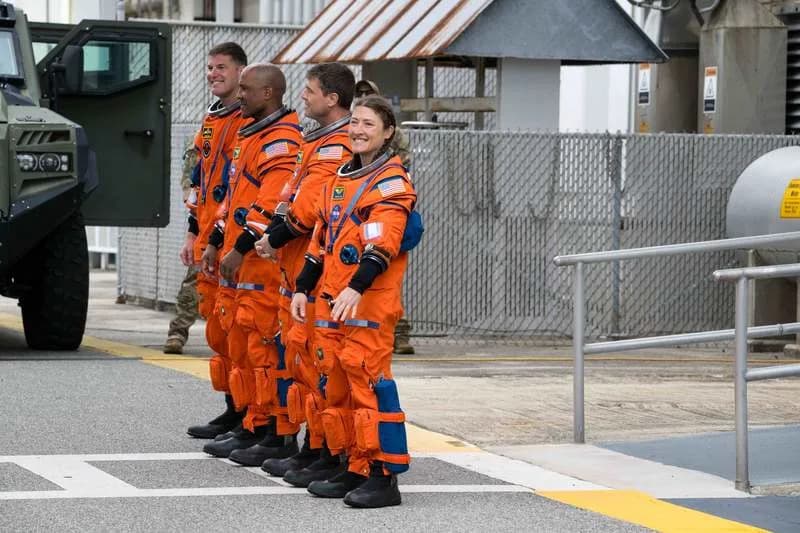
The NASA Artemis II astronauts walkout from the Neil A. Armstrong Operations and Checkout Building for launch aboard the Orion spacecraft at the Kennedy Space Center. NASA astronauts Reid Wiseman (2nd R), Victor Glover (2nd L), Christina Koch (R), and CSA astronaut Jeremy Hansen (L), are departing on a 10 day mission around the moon. Aubrey Gemignani/Nasa/Planet Pix via ZUMA Press Wire/dpa
NASA announced Wednesday that the four-person Artemis 2 crew is preparing to return to Earth and is scheduled to splash down in the Pacific on Friday evening. Weather forecasts currently favour recovery operations.
The crew — U.S. astronauts Christina Koch, Victor Glover and Reid Wiseman, and Canadian astronaut Jeremy Hansen — spent the day running additional scientific experiments, stowing equipment and readying the Orion capsule for re-entry. Mission controllers said the astronauts were woken with Queen and David Bowie’s "Under Pressure," a light moment during an otherwise busy return sequence.
Canadian public figure Mark Carney congratulated the team via live link, telling them, "couldn't be more proud of you." (Note: Carney is not the Canadian prime minister; this version corrects an earlier mislabel.)
NASA manager Rick Henfling said Artemis 2 is expected to reach a peak re-entry velocity of about 10,657 meters per second, below the 11,094 meters per second recorded by Apollo 10.
Mission Context
The Artemis 2 crew launched last week from Cape Canaveral, Florida, aboard the Orion capsule atop the Space Launch System rocket. The mission completed a crewed lunar flyby, making these astronauts the first humans to travel near the Moon in more than 50 years. During the flight they traveled farther from Earth than any humans have in decades.
What Happens Next: Recovery teams will monitor weather and sea conditions ahead of the planned Pacific splashdown; if conditions change, NASA will adjust timing or recovery procedures as needed.
The crew and mission control will continue final checklists and experiments until re-entry. NASA has positioned recovery forces and is coordinating with partner agencies to ensure a rapid and safe retrieval once the capsule returns to Earth.
Help us improve.