Lead Stories found no evidence that CNN relied on a "fake Nigerian site" for its April 7, 2026 Iran coverage. CNN initially summarized a Supreme National Security Council statement that was published by Iranian state and semi-state media; the document President Trump posted was a different foreign ministry statement signed by Seyed Abbas Araghchi. CNN says it obtained the material from Iranian officials and later included both documents in its live coverage. Searches found no matching Nigerian source for the language CNN cited.
Fact Check: No Evidence CNN Used a 'Fake Nigerian Site' in Reporting Iran Ceasefire Statements
Lead Stories says: Iran's Sites
Claims that CNN relied on an unnamed "fake news site from Nigeria" to report on Iranian ceasefire statements on April 7, 2026 — as alleged by U.S. President Donald Trump — are not supported by the available evidence, according to Lead Stories.
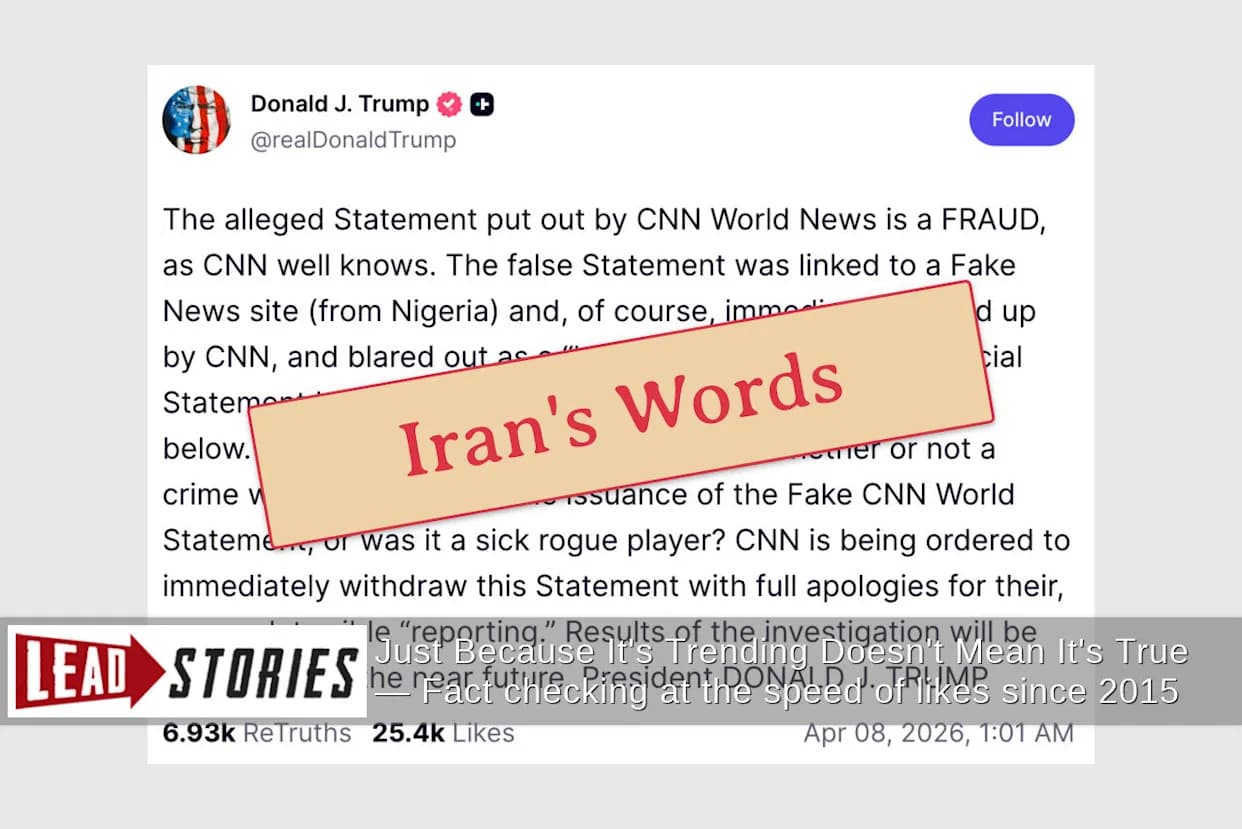
On April 7, 2026, President Trump posted on Truth Social accusing CNN World News of republishing a fraudulent statement sourced from a Nigerian website and demanding that the network retract the story and apologize. The post included a document labeled the "Official Statement Of Iran," signed by Seyed Abbas Araghchi and posted on Iran's Ministry of Foreign Affairs website.
Two different documents were involved. The document Trump shared was presented as a foreign ministry statement signed by Araghchi that thanked mediators and offered conditional halts to defensive operations and temporary safe passage through the Strait of Hormuz. Separately, CNN's initial live report summarized a different statement attributed to Iran's Supreme National Security Council that asserted Iran had forced the United States to accept a 10-point plan in principle.
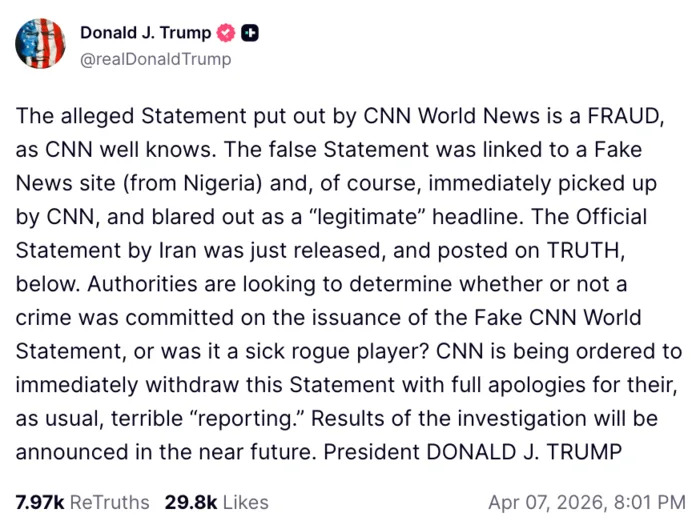
Image source: post by @realDonaldTrump on Truth Social.
CNN's coverage explicitly said the report was "according to a statement from Iran's Supreme National Security Council reported by Iranian state media." Lead Stories verified that the version summarized by CNN appeared on multiple Iranian state and semi-state outlets, including PressTV and Tasnim News. That statement contained language claiming significant concessions by the United States, including non-aggression commitments, control over the Strait of Hormuz, acceptance of enrichment, lifting of sanctions, and other terms.
CNN Response: A network spokesperson told Lead Stories that the material was published on CNN's live story feed — which updates throughout a developing event — and that the statement was obtained from Iranian officials and reported by multiple Iranian state media outlets. CNN also said it received the document from specific official Iranian spokespeople known to the network.
On live television, CNN senior international correspondent Matthew Chance told Anderson Cooper that he had contacted Iran's foreign ministry after the president's post; the ministry sent him the document and it matched what CNN already had, giving the network confidence in its authenticity.
Lead Stories attempted to verify the president's claim about a Nigerian source. Searches using precise language from the Supreme National Security Council statement showed no exact matches on Nigerian websites dated to April 7, 2026. The White House had not responded to requests for clarification about which Nigerian site was being referenced by the time of Lead Stories' publication.
Conclusion
Available records indicate CNN cited statements published by Iranian government and semi-government media and that the network said it obtained the material from Iranian officials. Lead Stories found no evidence to support the specific allegation that CNN relied on a "fake news site from Nigeria." CNN later updated its live coverage to include both the foreign ministry statement shared by President Trump and the separate Supreme National Security Council statement it had earlier summarized.
Help us improve.