Ronald Brecher photographed NGC 2359 — "Thor's Helmet" — a 30-light-year-wide emission nebula about 15,000 light-years away in Canis Major. The bubble and wing-like extensions were sculpted by a central Wolf–Rayet star estimated at ~16 solar masses and ~280,000 times the Sun's luminosity. Brecher recorded 124 exposures (just over eight hours) from Guelph, Canada, and processed the frames in PixInsight despite significant local light pollution. The nebula highlights how massive stars reshape their surroundings before an eventual supernova.
Thor's Helmet: Astrophotographer Captures Stunning Image of NGC 2359 15,000 Light-Years Away
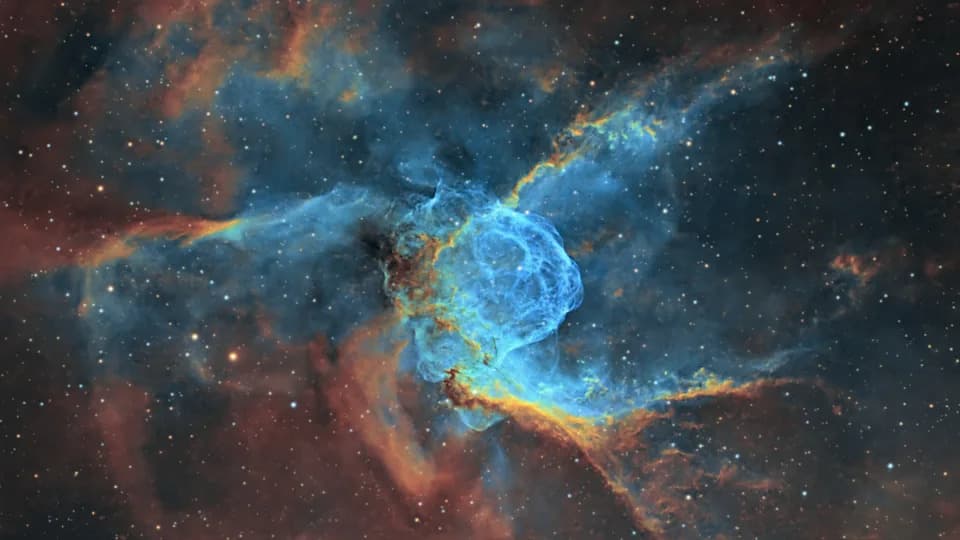
NGC 2359 glows in the constellation Canis Major. | Credit: Ronald Brecher
An astrophotographer has captured a striking deep-space image of NGC 2359 — the nebula nicknamed "Thor's Helmet" — revealing fine structural detail around a massive star roughly 15,000 light-years from Earth in the constellation Canis Major.
Details of the Image
Ronald Brecher photographed the emission nebula NGC 2359, a structure about 30 light-years across whose bubble-like shape has been carved by powerful winds from a Wolf–Rayet star at its center. According to the Lowell Observatory, that central star is estimated to be roughly 16 times the mass of the Sun and some 280,000 times more luminous.
How It Was Captured
Brecher recorded the target from Guelph, Canada, between March 8 and March 13, 2026, using a Celestron 14-inch EDGE HD telescope fitted with a monochrome astronomy camera and narrowband filters. He collected 124 individual exposures totaling just over eight hours of integration time, then aligned, stacked and processed the data in PixInsight to produce the final image.
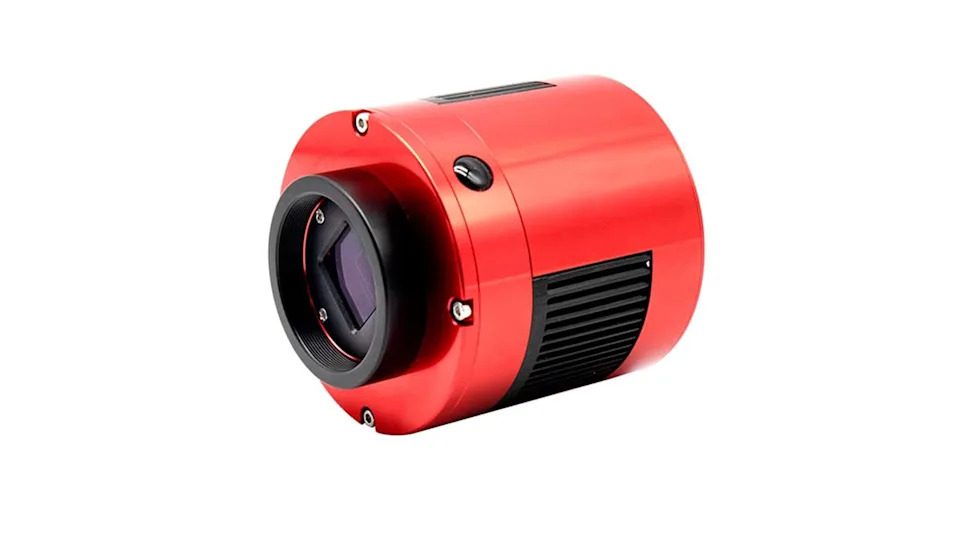
A product photo of the ZWO ASI1533MC Pro Camera
Challenges and Significance
Processing and patient data collection were essential: Brecher captured the faint ionized glow of the nebula under difficult observing conditions, contending with tree lines and the glow of nearby light pollution. The resulting image nevertheless reveals sweeping, wing-like extensions of gas and ionized material that give the nebula its helmet-like appearance.
"I didn't think I could capture Thor's Helmet from my location," Brecher said. He noted the target skimmed trees and was photographed against the glare of local lighting, yet the stacked result nevertheless reveals impressive detail.
Why NGC 2359 Matters
NGC 2359 is an important laboratory for studying the late-life behavior of massive stars. The sculpting action of the Wolf–Rayet star's intense stellar wind foreshadows a more violent fate: in time the star will likely end its life in a supernova explosion, which will dramatically reshape the surrounding interstellar medium.
Want To Share Your Photos? Space.com invites readers to submit nebula images and comments (include name and location) to [email protected].
Help us improve.