In brief: An open-source investigation reviewed by Reuters finds a Patriot interceptor likely detonated over Bahrain's Mahazza neighborhood on March 9, injuring 32 people. Video, audio and satellite geolocation link the missile's trajectory to a Patriot battery near Riffa about 4 miles away. Researchers say the evidence points to a mid-air detonation—either during an attempted intercept of a low-flying drone or a malfunction—raising concerns about using high-end interceptors over residential areas.
Analysis: U.S.-Operated Patriot Interceptor Likely Linked To Bahrain Mahazza Blast
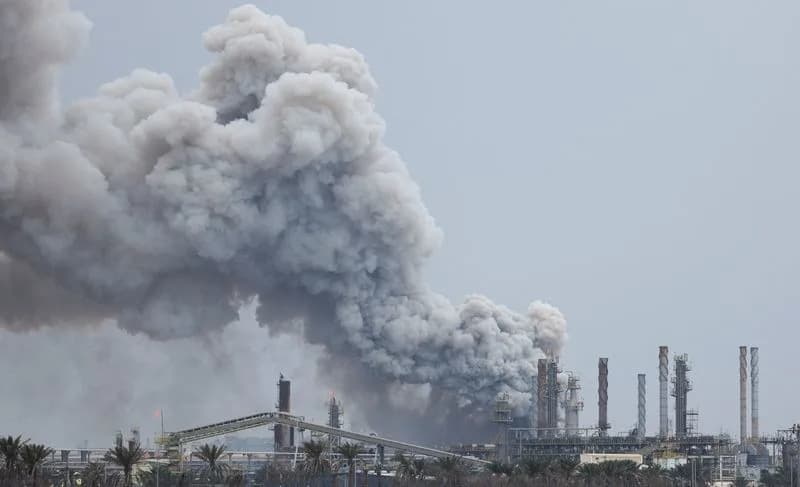
Smoke rises following a strike on the Bapco Oil Refinery, amid the U.S.-Israeli conflict with Iran, on Sitra Island Bahrain, March 9, 2026. REUTERS/Stringer
Summary: An open-source academic investigation reviewed by Reuters concludes a Patriot interceptor likely launched from a U.S.-operated battery detonated over the Mahazza neighborhood in Bahrain on March 9, injuring dozens and damaging homes. The analysis uses video, audio and satellite imagery to trace the missile's trajectory to a Patriot site near Riffa.
What Happened
On March 9, a pre-dawn explosion tore through residences in the Mahazza neighborhood on Sitra island, Bahrain, injuring 32 people, including children. Bahrain and U.S. officials initially blamed an Iranian drone strike. On March 20, Bahrain acknowledged that a Patriot interceptor was involved in the incident, saying the missile intercepted an alleged drone mid-air and that the damage was not caused by a direct ground impact.
Open-Source Analysis
Researchers Sam Lair, Michael Duitsman and Professor Jeffrey Lewis of the Middlebury Institute reviewed open-source video, audio and commercial satellite imagery and concluded with moderate-to-high confidence that the suspect interceptor was likely fired from a Patriot battery about 4 miles (7 km) southwest of Mahazza, near Riffa. Reuters shared the analysis with independent target-analysis experts and a Patriot-system missile researcher, who found the methodology and conclusions credible.
Evidence And Methods
Key evidence includes a night-time video filmed from an apartment building in Riffa showing a missile streaking on a northeasterly course, angling downward and disappearing from view, followed 1.3 seconds later by a distant flash. Digital-forensics and audio specialists reviewed the clip and found no obvious signs it was fabricated. Geolocation of the video and damage photos, cross-referenced with commercial satellite imagery, places the missile trajectory back to a Patriot battery visible near Riffa where five launchers were present two days before the incident.
Possible Scenarios
The Middlebury team outlines two plausible explanations: (1) the Patriot intercepted a low-flying drone and the combined explosions caused the ground damage, or (2) the interceptor's warhead and remaining propellant detonated in flight without direct contact with another aircraft. The researchers judge direct contact with a drone less likely based on available imagery and the direction of damage, but they cannot rule it out. Reuters could not independently confirm whether an Iranian drone was present.
Official Responses And Limits Of The Investigation
Bahrain has not said whether its forces or U.S. personnel fired the interceptor. The Pentagon referred Reuters to U.S. Central Command, which has previously stated an Iranian drone struck a residential area and called alternative explanations a "lie." Raytheon (RTX), builder of the Patriot system, did not comment for this report. Investigators were unable to obtain missile or drone fragments; several witnesses declined to speak to Reuters citing fear of reprisals.
Wider Context And Risks
The incident highlights the tactical and ethical dilemma of using high-end interceptors to defend against low-cost drones: powerful interceptors can themselves cause substantial collateral damage when detonations occur over populated areas. Patriots are commonly fired in pairs; video shows a steeper earlier smoke trail consistent with a prior intercept attempt, but the fate of that missile could not be determined.
Unanswered Questions
- Was a drone present over Mahazza at the time of the explosion?
- Which operator — Bahraini or U.S. — actually fired the suspect interceptor?
- Could forensic inspection of fragments confirm the sequence of events?
Conclusion: The open-source analysis presents strong geolocation and audiovisual evidence tying the intercept to a Patriot battery near Riffa, and shows that a mid-air detonation of the interceptor is consistent with on-the-ground damage. Important questions remain about the presence of a drone, the firing party, and how to reduce civilian risk when intercepting low-altitude threats over populated areas.
Help us improve.