James Webb has captured detailed new images of PMR 1, a planetary nebula nicknamed the "Exposed Cranium" in the constellation Vela, roughly 5,000 light-years away. Webb’s NIRCam shows a pale outer ring and orange inner lobes split by a dark stripe, while MIRI reveals bluer, denser interior structures where dust obscures the stripe. First seen by Spitzer in 2013, PMR 1’s expanding shell will persist for thousands of years; its central star is expected to become a white dwarf.
James Webb Reveals the 'Exposed Cranium' — Stunning New Views of a Dying Star's Nebula
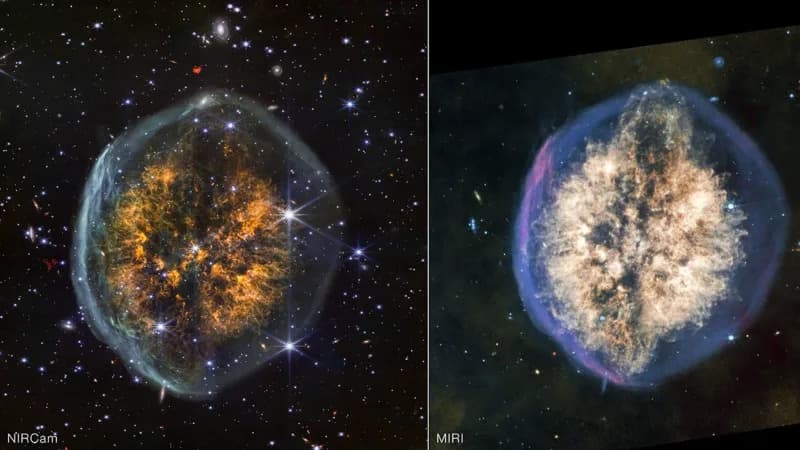
Webb reveals “Exposed Cranium” nebula | NASA, ESA, CSA, STSc
Something in the constellation Vela — a southern Milky Way region best seen from the Southern Hemisphere — resembles a brain floating in space. Astronomers nicknamed the object the "Exposed Cranium," and new observations from the James Webb Space Telescope now show the nebula in far greater detail.
The object, catalogued as PMR 1, lies roughly 5,000 light-years from Earth. It formed when a star in the late stages of its life began shedding its outer layers, sending gas and dust outward; that expanding shell is the structure telescopes now detect.
From a distance, the nebula’s shape helps explain the nickname: a glowing inner cloud sits within a faint outer bubble, evoking the image of a skull with its top peeled back. Webb imaged PMR 1 with two of its instruments, and each reveals a different aspect of the same object.
Two Complementary Views
One view comes from Webb’s Near-Infrared Camera (NIRCam). In that image, the nebula’s outer shell appears as a pale ring while the interior clouds glow orange. A dark stripe runs down the middle, dividing the structure into two lobes that resemble the two halves of a brain.
The second view was taken with Webb’s Mid-Infrared Instrument (MIRI). At these longer wavelengths, the surrounding bubble shifts to blue and purple tones while the interior looks denser and more tangled. The dark central stripe seen with NIRCam is less apparent in MIRI’s image because dust within the nebula obscures portions of the view.
Why Multiple Wavelengths Matter
Examining PMR 1 across multiple infrared bands highlights one of Webb’s strengths: each wavelength reveals different components of the nebula — gas expelled at different times, clumps of dust, and the faint outer shell drifting away from the progenitor star.
PMR 1 was first detected in 2013 by the now-retired Spitzer Space Telescope, but it had not been examined in comparable detail until Webb’s recent observations. These new images let astronomers study the nebula’s layered structure and the interplay of gas and dust with unprecedented clarity.
What Happens Next?
Planetary nebulae like PMR 1 represent the late stages of stellar evolution for low- to intermediate-mass stars. As such stars exhaust their nuclear fuel, they eject their outer layers and leave behind a hot core that cools into a white dwarf. Very massive stars produce supernovae, but that fate is not expected for typical planetary-nebula progenitors. The central star’s exact mass for PMR 1 remains to be measured, but the classification as a planetary nebula points toward a white-dwarf end state.
Meanwhile, the glowing shell around PMR 1 will continue expanding for thousands of years, slowly thinning until it fades into the Milky Way.
Sources: NASA, ESA, STScI, Live Science; original detection: Spitzer Space Telescope (2013).
Help us improve.