Hardline clerics are urging a rapid appointment of Iran’s next supreme leader amid renewed U.S. and Israeli strikes. Some clerics say the interim three-member council should not retain authority long, and the Assembly of Experts may convene within 24 hours to choose a successor. Iran’s constitution requires a new supreme leader to be named within three months.
Hardline Clerics Push for Rapid Appointment of Iran’s Next Supreme Leader Amid Escalating Strikes
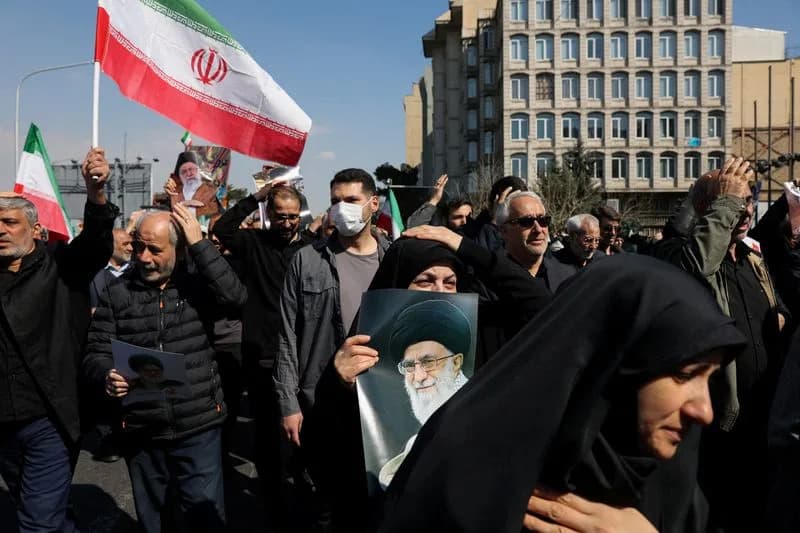
A demonstrator holds an image of Iran's late Supreme Leader Ayatollah Ali Khamenei, after he was killed in Israeli and U.S. strikes on Saturday, during an anti-Israeli and U.S. rally after Friday prayer, amid the U.S.-Israeli conflict with Iran, in Tehran, Iran, March 6, 2026. Majid Asgaripour/WANA (West Asia News Agency) via REUTERS
Hardline clerics in Iran have urged a swift decision to appoint a new supreme leader, Iranian media reported on Saturday, as the Islamic Republic faces a fresh wave of U.S. and Israeli strikes.
The appeals suggest unease within parts of the clerical establishment about leaving authority in the hands of the temporary three-member council that assumed the supreme leader’s duties after the killing of Ayatollah Ali Khamenei. That council comprises the president, a senior cleric and the head of the judiciary and is serving until the Assembly of Experts names a successor.
Late on Saturday, state outlets quoted Ayatollah Hossein Mozafari, a member of the 88-seat Assembly of Experts tasked with selecting the next supreme leader, saying the assembly could convene within 24 hours to make a decision. It was unclear whether any meeting would be held in person; some clerics have previously consulted online.
"An appointment is needed swiftly to help better organise the country’s affairs," said Grand Ayatollah Naser Makarem Shirazi, a leading marja whose religious rulings command a broad following, according to state media.
Last week, two senior Shi'ite religious authorities issued fatwas — religious decrees — calling on Muslims worldwide to avenge Khamenei’s killing. Makarem Shirazi described it as a religious duty "until the evil of these criminals is eradicated from the world." Grand Ayatollah Hossein Nouri Hamedani also urged the Assembly of Experts to speed up the succession process.
The constitution requires a new supreme leader to be chosen within three months. The international dimension of the succession has drawn attention: U.S. President Donald Trump said the United States should have a role in choosing the new leader, a proposal Tehran rejected.
As Iran navigates the immediate political vacuum and external pressure, the pace and manner of selecting a successor will be closely watched at home and abroad.
Help us improve.