The most carefully curated sample of old Milky Way stars peaks at an age of 13.6 billion years (±1.0 Gy statistical, ±1.4 Gy systematic). Accounting for a 0.2–0.4 Gy delay for first‑star formation implies a conservative cosmic age lower bound of 13.8–14.0 billion years. Converted to expansion rate constraints, the stellar ages imply an upper limit on H0 near 68.3 km/s/Mpc, closer to CMB‑based Planck results than to higher local measurements; however, systematic uncertainties and ≈11% contamination keep the conclusion tentative.
Ancient Milky Way Stars Suggest a ≥13.6 Billion‑Year Universe — Deepening the Hubble Tension
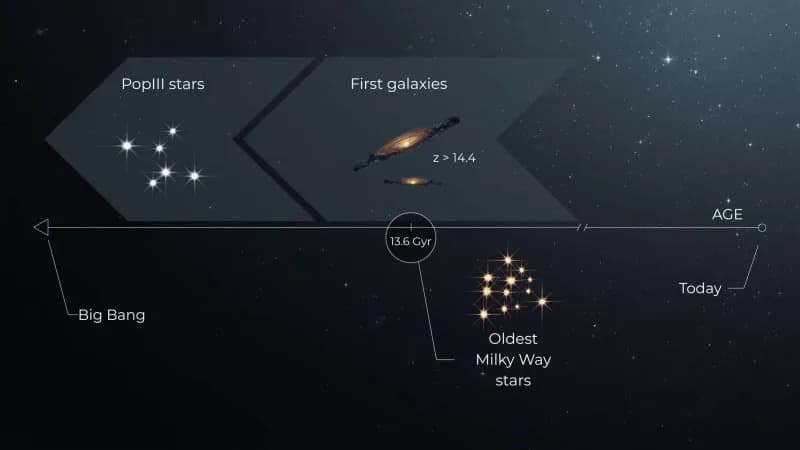
The oldest stars in the Milky Way provide information about the age of the universe. (CREDIT: Elena Tomasetti)
The oldest stars in the Milky Way are forcing a fresh look at one of modern cosmology's thorniest debates. A new analysis finds that a carefully vetted sample of field stars peaks at an age of about 13.6 billion years, implying the universe must be at least that old — a result that favors the older cosmic age inferred from the cosmic microwave background (CMB) and complicates the picture offered by faster local expansion measurements.
How the Study Was Done
Researchers from the University of Bologna, the Leibniz Institute for Astrophysics Potsdam (AIP), and other institutes used a catalog of roughly 202,384 Milky Way stars whose ages were estimated with the StarHorse Bayesian isochrone‑fitting code. Crucial inputs included precise parallaxes and spectroscopic data from ESA's Gaia DR3. The team focused on stars near the main‑sequence turn‑off and on the subgiant branch because these evolutionary stages provide especially age‑sensitive diagnostics.
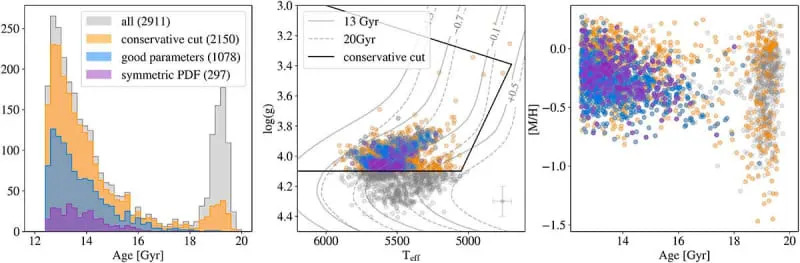
Age distribution (left), Kiel diagram (centre), and age-metallicity coverage (right) for each step of the selection process, before visual inspection. (CREDIT: Astronomy & Astrophysics)
From that large catalog the authors selected stars older than 12.5 billion years with formal uncertainties below 1.0 billion years, then applied a sequence of strict filters to exclude misclassified objects, stars affected by parameter degeneracies, and those with anomalous probability distributions. After visual inspection and removal of likely contaminants such as mass‑stripped stars and unresolved binaries, the final reference sample contained 160 stars.
Results And Implications
The cumulative age distribution of the reference sample peaks at about 13.6 billion years, with a statistical uncertainty of ±1.0 billion years and a systematic uncertainty of ±1.4 billion years. Adding a modeled delay of 0.2–0.4 billion years for the first stars to form after the Big Bang gives a conservative lower bound for the universe’s age near 13.8–14.0 billion years.
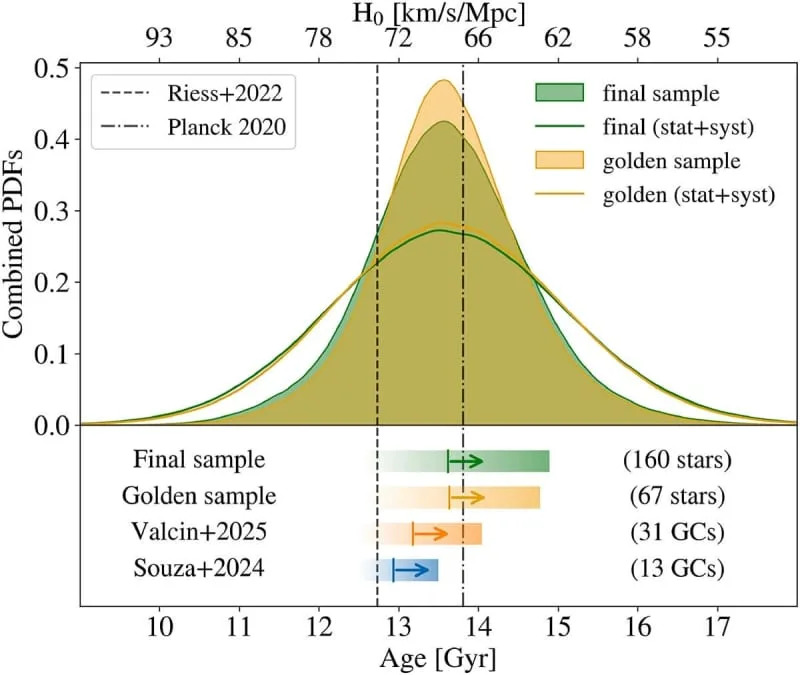
Cumulative posterior distribution in age for the final and golden samples. The distributions including the systematic component of the error are shown as solid lines in the same colours. (CREDIT: Astronomy & Astrophysics)
The authors converted that age bound into an upper limit on the Hubble constant, finding H0 ≲ 68.3 km s⁻¹ Mpc⁻¹ (with broad uncertainties). That value is much closer to the Planck CMB result (≈ 67.4 ± 0.5) than to higher local values obtained from Cepheid and supernova distance ladders (≈ 73.04 ± 1.04).
Caveats And Sources Of Uncertainty
The paper is careful not to overstate its conclusions. The relation between cosmic age and H0 depends on the assumed cosmological model and parameters such as matter density. The dominant limitations are systematic uncertainties in stellar modeling — for example, biases in alpha‑element abundances, assumptions about convection (mixing length), and the initial helium fraction — which together contribute about ±1.4 billion years of systematic error.
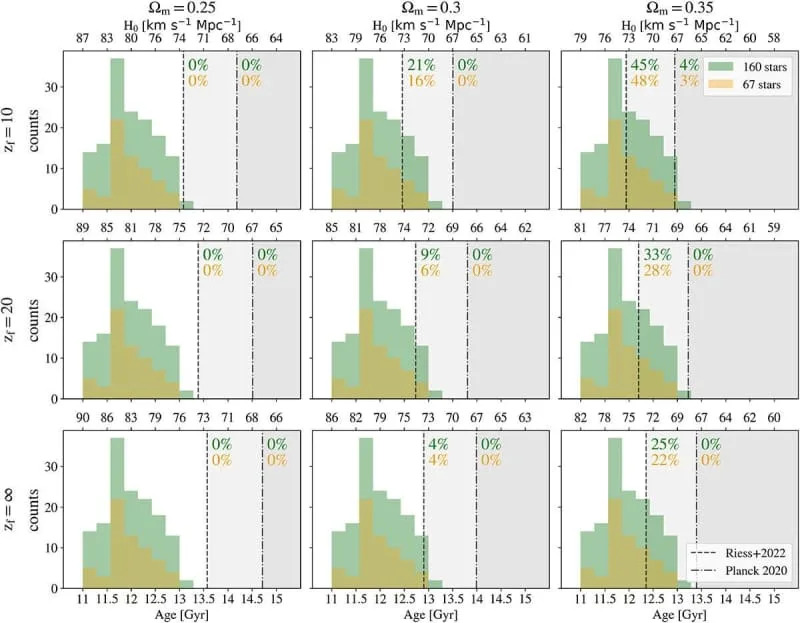
Distribution of the 10th percentile in age for the clean final (green) and golden (gold) samples. In each panel, the top axis shows the corresponding H0 values assuming a flat ΛCDM and a different value of Ωm and zf. (CREDIT: Astronomy & Astrophysics)
Contamination is another concern: the team identified a secondary, broader group of stars with apparent ages near 14.8 billion years and estimates that roughly 11% of the selected sample could be contaminants (mass‑stripped stars, unresolved binaries, or other misclassified objects). Because the ages come from single field stars rather than globular clusters, the result is an independent and statistically meaningful cross‑check — though still suggestive rather than definitive.
Looking Ahead
Future Gaia data releases, larger homogeneous samples, and targeted high‑resolution spectroscopy should reduce key systematic errors and better constrain stellar ages. If stellar age determinations become more accurate, the oldest Milky Way stars could become a robust, independent test of competing cosmological models and help determine whether the Hubble tension arises from hidden systematic errors or new physics beyond the standard model.
Publication: The study is available in Astronomy & Astrophysics.
Help us improve.