IBM Research has synthesized and imaged the first "half‑Möbius" molecule: an atomic ring whose electron clouds carry a 90° twist in orientation. The team validated their microscopic observations by simulating the molecule’s electronic states on IBM’s quantum computers and comparing simulated images to the experimental data. The result represents a milestone in topological chemistry and demonstrates a practical scientific application for quantum simulation.
IBM Creates First 'Half‑Möbius' Molecule — Validated with Quantum Simulation
IBM Research
Scientists at IBM Research have synthesized the first-ever "half‑Möbius" molecule: an atomic ring whose electronic arrangement carries a quarter‑twist topology. The team assembled the structure atom‑by‑atom using precision scanning probe techniques, imaged the resulting electron distribution with high‑resolution microscopy, and confirmed its unusual quantum topology by simulating the molecule on IBM’s quantum computers. The results were published today in the journal Science.
From Atom Manipulation To A New Topological Molecule
Building on techniques the lab helped popularize in 2013 — when IBM researchers arranged atoms to create the stop‑motion film A Boy and His Atom — the team selectively broke bonds and removed atoms from a more complex precursor until the ring adopted the desired geometry. With fine control over individual bonds and atoms, they produced an object that would be unstable under ordinary conditions but is accessible in the controlled environment of the microscope.
What Is A Half‑Möbius?
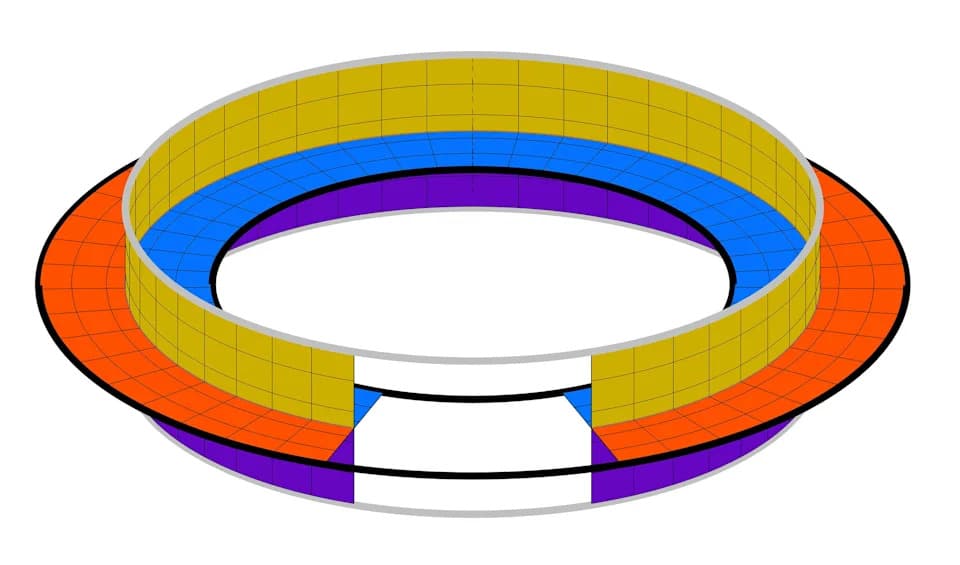
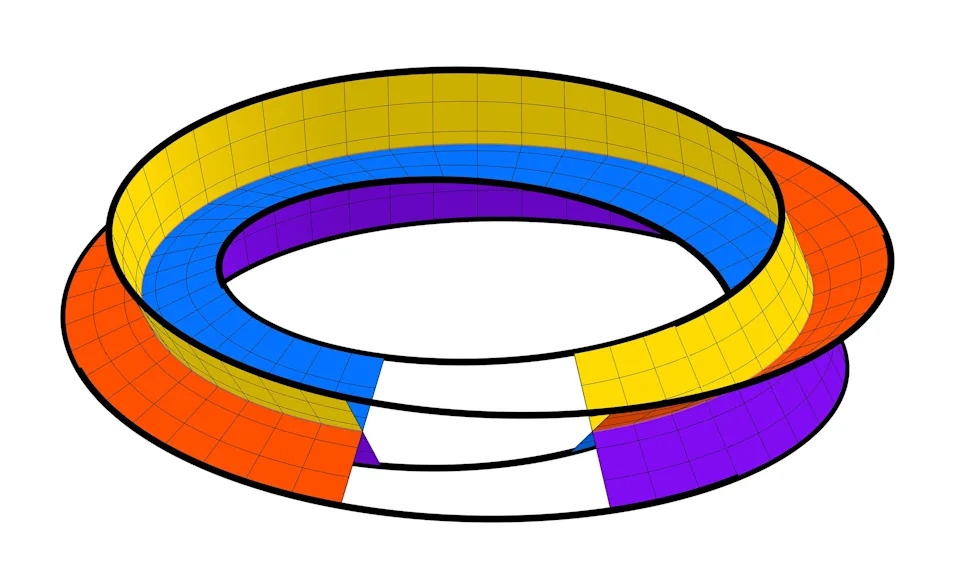
To understand the half‑Möbius, it helps to contrast it with a conventional “full Möbius” molecular ring. In a full Möbius system, each atom’s electron cloud often forms two lobes that flip orientation as you go around the ring, so a traced path flips after one circuit and returns to its original orientation after two. In the half‑Möbius, each atom’s electron cloud is cross‑shaped rather than simply up‑and‑down, allowing a 90° (quarter‑turn) twist in the electronic orientation instead of a full inversion. Visually, if an ant walked along the top band of this cross‑shaped loop, it would need four circuits to return to its original orientation — a useful analogy for the more complex electronic phase path in the molecule.
IBM Research
Imaging, Simulation, And Confirmation
Electron clouds are inherently quantum and diffuse, so even the best scanning probe microscopy produced only a hazy experimental image of the cloud shapes. To test the topology, the researchers ran quantum simulations on IBM’s quantum hardware to model the molecule’s electronic states and to generate simulated microscope images. They compared those simulations to both the experimental image and simulations of an untwisted control molecule. The agreement between experiment and quantum simulation provided strong evidence that the synthesized structure is indeed a half‑Möbius.
“We made this freakish molecule in these very special conditions,” said Leo Gross of IBM Research, emphasizing that such structures would not be stable in ordinary natural environments.
Why This Matters
The work advances the field of topological chemistry, where molecular shape and quantum phase combine to produce novel electronic behaviors. External experts noted the significance: Yasutomo Segawa of the Institute for Molecular Science (not involved in the work) said that turning a previously theoretical possibility into a real, synthesized molecule will have a major impact on molecular science.
The project also highlights a concrete application for quantum computing in chemistry. The team ran parallel calculations on classical computers but used qubits to scale quantum simulations more efficiently as the number of electrons and allowed quantum states increased. According to team member Ivano Tavernelli, qubit counts in relevant experiments have expanded dramatically in the past decade, enabling simulations that would be impractical with classical resources alone.
Taken together, the experiment demonstrates how precise experimental control and emerging quantum simulation tools can uncover and confirm novel quantum phenomena at the molecular scale — opening new avenues for research in materials science, molecular electronics, and quantum chemistry.
Help us improve.